Historical overview
Bronze Age
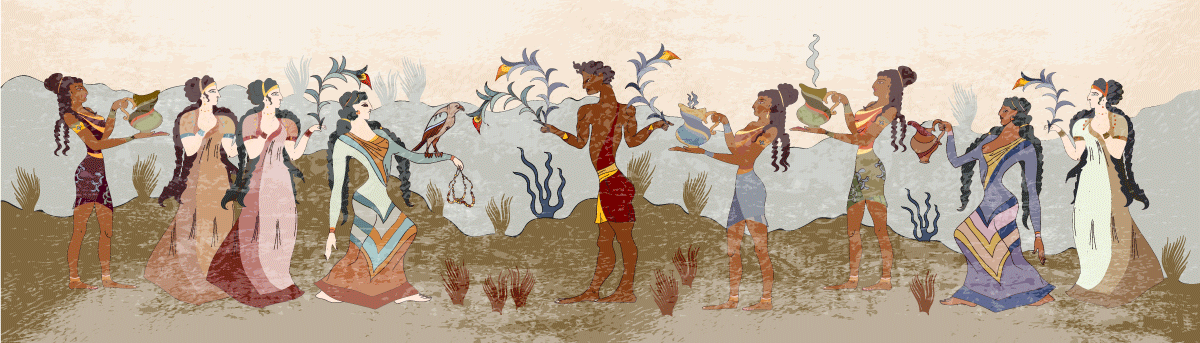
matrioshka / Shutterstock.com |
|
These early settlements continued to grow and learn, slowly but surely. By c. 3200 BCE, with the emergence of the Cycladic people, Greece had entered the Bronze Age. The Bronze Age is characterised by the ability of people to learn how to make and use bronze tools. By c. 2000 BCE, the Minoans had established themselves as a true civilisation on the island of Crete, complete with palaces, art and a writing system. Capable of building cities and ships, the Minoans flourished for a time as traders, but they were plagued by a series of natural disasters, including volcanic eruptions, earthquakes and fires. Meanwhile, on the mainland, a new warrior culture, the Mycenaeans, had emerged with significant influence from the Minoans. After a huge earthquake and fire devastated the Minoans c. 1450 BCE, the Minoans power declined, and the Mycenaeans became the cultural and political leaders of the region (possibly after invading Crete). The Mycenaeans adopted the Minoans' art, architecture and writing system. The Mycenaeans used writing to facilitate trade and the bureaucratic organisation of their growing political realm. Using long boats to travel across the Mediterranean, the Mycenaeans established extensive trading networks with people all over Europe, exchanging locally produced goods, such as olive oil and wine, for metals, spices and other goods. As both fierce warriors and efficient bureaucrats, the Mycenaeans flourished until c. 1100 BCE, when a range of factors, which we do not fully understand, led to the collapse of Mycenaean culture. One of the main reasons for this lack of understanding is that writing, along with many other forms of cultural expression, was lost during this time and did not reappear until the Archaic Age, hundreds of years later. Researchers believe that a major factor in this collapse may have been political infighting among the upper classes that then led to economic and societal decline. Since the lower classes were illiterate, the disappearance of the upper classes left only an oral tradition of Mycenaean history and culture. This collapse in ancient Greece and its neighbouring civilisations meant that the trade networks largely broke down, leading to a period of comparative isolation. |