Spanish Empire: Motivations
|
Spain’s empire was established with the voyages of Christopher Columbus to the Caribbean in 1492. This week, we are going to examine the motivations behind the Spanish crown’s decision to invest in this risky undertaking as well as Columbus’s personal reasons for going. Events don’t occur in a vacuum so we will also be looking at some of the long- and short-term causes and consequences of the voyages. These include technological advances, political rivalry, religious zeal and economics. It is important here to make some distinctions between long- and short-term causes and consequences. Some events generate effects that are immediately felt. The fall of Granada, as we shall see, led to the end of the Spanish leader’s focus on the ongoing war of the Reconquista so that they looked to other opportunities. Others take longer to have an effect, such as the evolution of marine technology that allowed Columbus to sail into the open ocean. Both factors were significant contributors to the voyages. To properly understand the Spanish Empire, it is necessary to first understand the geography that bound it and shaped its growth. The physical environment determined the way in which the empire grew as well as the type of people who came to be at the forefront of its expansion. So, let’s begin with ground zero – Spain. The geography of Spain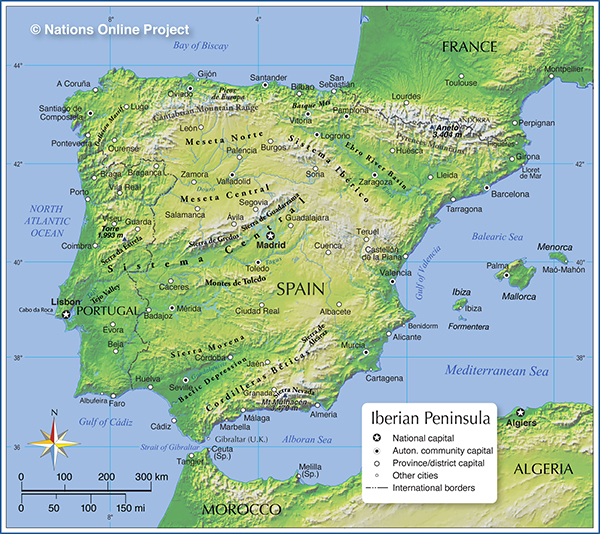
Copied under s113p. SpainMap360°, https://spainmap360.com/spain-geography-map. Accessed 21 August 2026 Spain makes up most of the Iberian Peninsula in south-western Europe. It shares a border with France to the north and Portugal to the west. The first thing that strikes you about Spain is how close it is to North Africa. From the Rock of Gibraltar (which is geographically part of Spain but politically a British territory) to the African town of Ceuta (which is geographically part of Morocco but politically a Spanish territory) is a distance of only 14 km. This proximity has had a profound impact on Spain’s history as it was for centuries a transition zone between the cultures and peoples of Christian Europe and Muslim North Africa. The next geographical consideration is Spain’s maritime situation. Being on a peninsula, it is surrounded by oceans – the Mediterranean to the west, and the Atlantic to the east and to the north. It sits at the crossroads of sea lanes between northern Europe, the west coast of Africa and the Mediterranean and, of most importance to our study, has a section of coast that faces into the open Atlantic and the sea routes to the Americas. The third geographical consideration is the climate. While it is wetter in the north, the dominant climate in Spain is dry with temperatures increasing as you go further south. This aridity and the mountainous topography means there is less arable (crop-growing) land available than the neighbouring European countries, which leads to a tendency towards maritime industries and trade. Spain is also comprised of several islands. The most relevant to our study are the Canaries which lie off the Atlantic coast of modern Morocco, 1500 km southwest of Gibraltar. In 1492 they were the closest point of Spanish held territory to the New World. |