Advances in marine technology
|
European marine technology gained momentum in the centuries prior to the 1400s under the pressure of growing economies in the North and South. Ship building and navigation had advanced by 1415 to a point where sailors could expect with some confidence to be able to sail into uncharted waters and return safely. ShipsPrior to the Middle Ages, European shipping had been mostly concerned with sailing in the Mediterranean, never venturing too far from shore. The main type of ship was the galley, a rowing vessel that had low sides so that the oars could easily reach into the water. At the end of the day a galley would pull into a safe harbour so that the crew could get a good night’s rest before continuing with their journey the next day. Because of their low sides they were vulnerable in high seas to swamping. 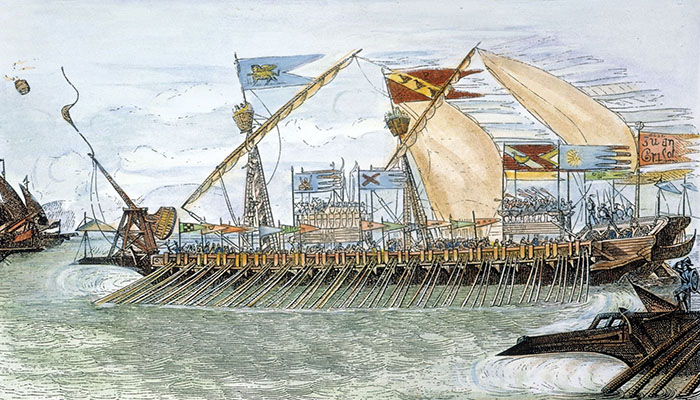
Quinto Cenni, public domain. Accessed 16 May 2020. Voyaging into the Atlantic required a different type of navigation and vessel. The first revolutionary design came to the Mediterranean around 1300 AD from Northern Europe where trade between the Baltic Sea and the Netherlands involved crossing the North Sea which was much rougher than the Mediterranean. The ship that evolved was called a cog. It had high sides and was wide in the middle, which made its cargo hold much larger. It didn’t need as many crew and did not need to pull into port every night which made journeys faster. The cog also had a rudder and steering wheel; prior to this, ships had used a giant oar hanging from the rear which was unwieldy and imprecise. Improvements were made in the sails which were originally simply square-rigged. This limited the ship’s ability to sail into the wind and further refinements came with the use of a second mast and triangular lateen sail, which increased manoeuvrability. The addition of shelter for the crew and extra supplies in the fore and aft castles allowed for lengthier trips. 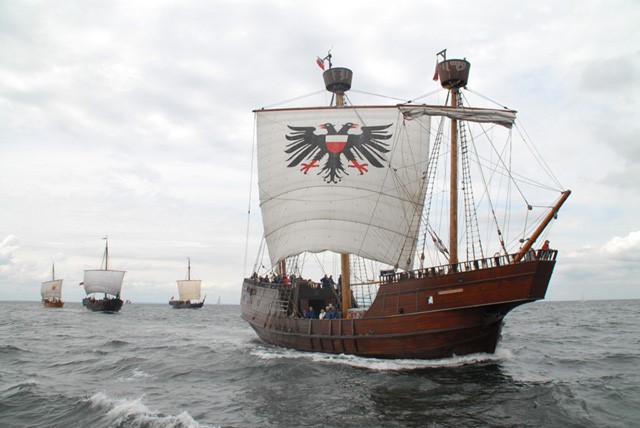
Copied under s113p. tallship-fan.de, http://www.tallship-fan.de/news/koggentreffen/index_e.htm. Accessed 16 May 2020 Most significantly, increased sea-worthiness and the ability to sail into the wind made sailing a year-round activity. Before this, journeys were limited to once a year as winter conditions were avoided and the prevailing winds dictated when you could go in a certain direction. By the 1400s a larger ship called a carrack had evolved which boosted the amount of cargo beyond any galley. 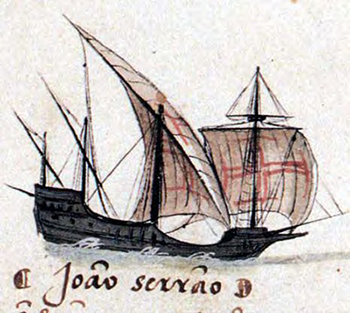
Livro das Armadas, public domain. Accessed 21 August 2026 The caravel was a smaller more agile form of the carrack, and was perfect for exploratory sailing both across the open sea and along coastlines. It was in this type of vessel that the Portuguese and Spanish made their great voyages. |