The unification of Castile and Aragon
|
Spain as a single nation did not exist in 1492. It was divided between four kingdoms: Castile, Aragon, Granada and Navarre. 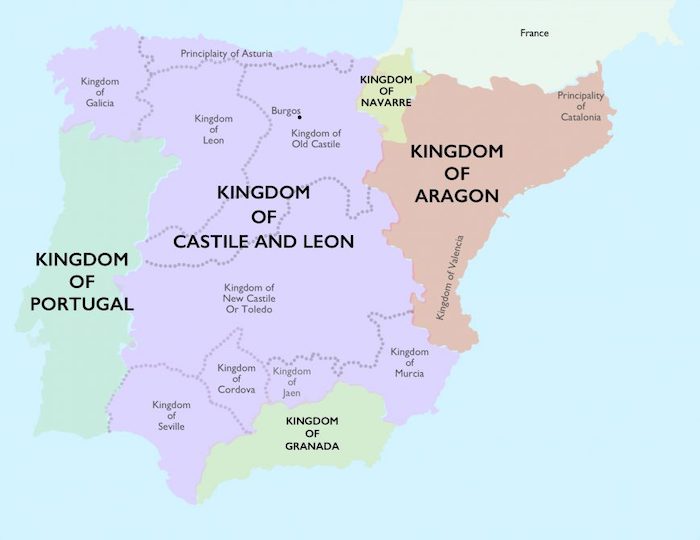
Copied under s113p. Smarthistory, https://smarthistory.org/fifteenth-century-spanish-painting-an-introduction/. Accessed 21 August 2026 In 1462, the kingdoms of Aragon and Castile were united by the marriage of Queen Isabella of Castile and King Ferdinand of Aragon. The unification of these kingdoms removed the rivalry that had existed between them although technically they continued to exist with their own governments and legal systems. The Pope recognised the marriage as being between two equal monarchs and Ferdinand did not have power over Isabella. In fact Castile being a much larger kingdom, Isabella was the more powerful of the two. As a sign of this, Isabella was able to ensure that her crown would not be inherited by the children of their marriage, but by members of her own family. 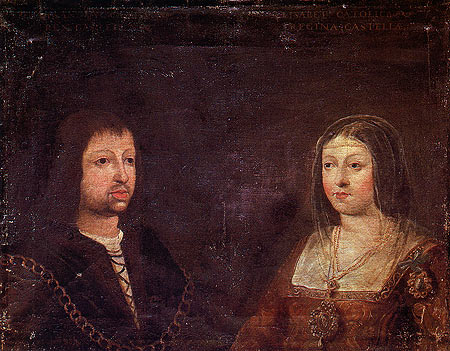
Duoda, Women Research Center. University of Barcelona, public domain. Accessed 30 March 2021. The joining of the two kingdoms allowed them to focus on national tasks (without the complication of competing with each other), such as expelling the Moors from Granada in the south. This was the final part of the Reconquista, a campaign that had begun when the Muslims of North Africa had invaded the Iberian Peninsula in the 700s and almost completely occupied it. The fight against the Moors had been conducted as a crusade with the full backing of the Pope and had at times involved troops from most of the Christian kingdoms of Western Europe. By 1492 Granada had been defeated and its Muslim inhabitants given the choice of conversion or exile. Many chose the latter. |