What is data?

Qualitative and quantitative data
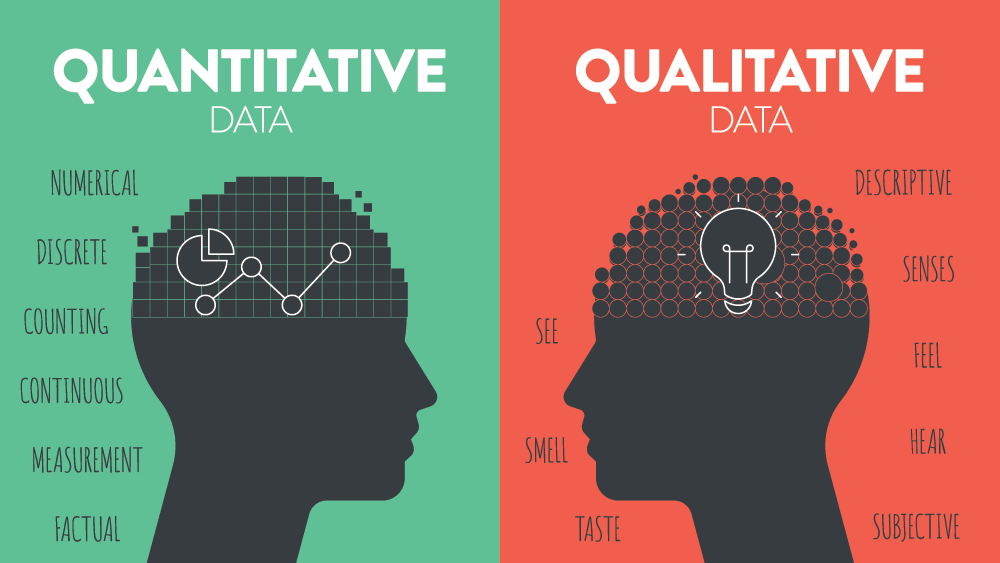
Illustration of two human head silhouettes facing each other - left has heading 'Quantitative data' and the words 'numerical', 'discrete', 'counting', 'continuous', 'measurement', and 'factual' on a green background - right has heading 'Qualitative data' and the words 'see', 'smell', 'taste', 'descriptive', 'senses', 'feel', 'hear', and 'subjective' on a red background.

Whale Design / Shutterstock.com

Qualitative data

Qualitative data refers to descriptive information that cannot be measured in numbers. Instead, it describes characteristics, qualities, or experiences. This type of data answers questions like 'what', 'how', or 'why'. Qualitative data is often used to gain deeper insights into behaviours, opinions or feelings. Examples of qualitative data include:

  • descriptions of colour (blue, red)
  • customer feedback (satisfied, needs improvement)
  • interview responses (narratives or quotes)
  • observations (the room was crowded).

Quantitative data

Quantitative data refers to information that can be measured and expressed using numbers. This type of data answers questions like 'how much', 'how many', or 'how often'. It is often used in statistical analysis to identify patterns, trends or relationships. Examples of quantitative data include:

  • test scores (85 out of 100)
  • temperature readings (25°C)
  • sales figures (150 units sold)
  • heights of people (170 cm).

A smartphone might have the following qualitative and quantitative data.

Qualitative Quantitative
Sleek and modern design 12-hour battery life
Intuitive user interface 128 GB storage
Sturdy build quality 6.5-inch screen
Well known brand Weighs 180 grams
Available in a range of cool colours 12 megapixel camera