Analysing for differences
Structure: Breaking it down
|
On first listening of the excerpt of 'It's oh so quiet', we can notice immediate differences between the alternating sections of the track. The most obvious change is in volume - the piece begins softly, and the dramatic change comes with a loud blast. We can therefore say that there is a change in dynamics – soft to loud. At this most basic level of response, we could map out the following sections in the music based simply on dynamics: A sections are soft, B sections are loud. 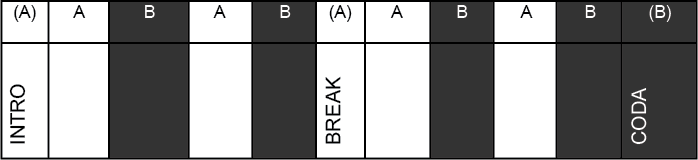
© State of Victoria (DE) Virtual School Victoria 2022 Note that the sections above are also broken into smaller ideas – the short introduction before the singing begins; the similar break from the vocals in the middle, and the coda (a musical term for an ending section) when the piece finishes. When we do this, we are actually mapping out a graphic representation of the form of the piece. When you look more closely at the sections, you can then add more information into the separate sections. Some other obvious distinctions between the sections can be noted:
But saying this doesn’t give a real indication of the stark changes that occur between the sections. To really describe the differences, we need to pinpoint some more detailed treatment of elements. We could do this by many repeated listenings – but it is often quicker if you also have a score (the notated music) to check your aural observations. While the written music does not contain all aspects of the sounds we hear (there is no drum-kit notation, for example), it does let you see how things are put together. |