Earth’s four systems
Atmosphere and hydrosphere
Atmosphere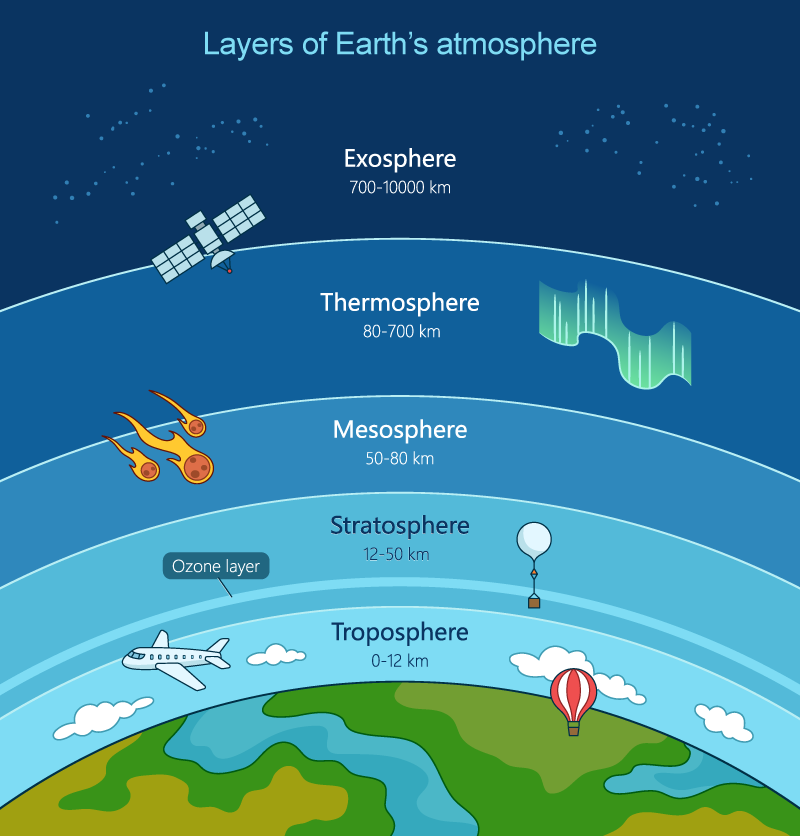
Adapted from Alexander_P / Shutterstock.com The atmosphere contains all of the gases. It is comprised mainly of nitrogen and oxygen with trace elements of many other gases. It has five layers: troposphere, stratosphere, mesosphere, thermosphere and exosphere. The layers differ in temperature, density and chemical composition. The atmosphere is not just a passive component that supplies oxygen. It plays a crucial role in heat regulation by absorbing and scattering the sun’s energy as well as heat emitted and reflected by the Earth’s surface. Due to gravity, air is densest near the Earth’s surface in the troposphere. It is within the troposphere, which extends from the surface up to an altitude of 15 km, that all life exists. This layer also contains almost all of the atmospheric mass, primarily consisting of nitrogen and oxygen, with smaller amounts of water vapour, carbon dioxide and inert gases. The troposphere absorbs a lot of the Sun’s energy, ensuring Earth's temperature remains within a range that can support life. Between 15 km and 50 km above the surface is the stratosphere, where the ozone layer exists. The ozone layer provides vital protection for living things as it absorbs many of the Sun’s harmful rays. The thermosphere absorbs some of the Sun’s high-energy radiation, helping to protect life on Earth. Auroras also occur in this layer. The outermost layer is the exosphere, where gases are extremely spread out and gradually merge with space. Hydrosphere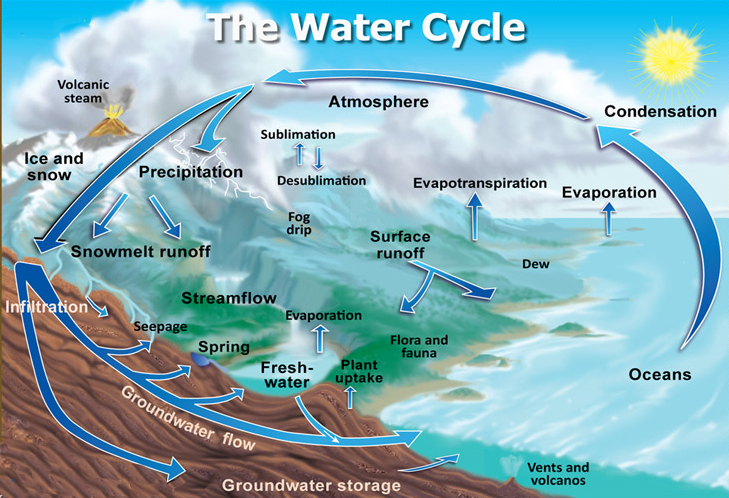
Water-Cycle Diagram by John Evans and Howard Periman, USGS, public domain. Accessed 17 August 2026. The hydrosphere features liquid and frozen water, seas, rivers, ice caps and snow. Water is the most abundant liquid on Earth and is essential for life. The vast majority (97%) of Earth's water is in the oceans, and of the remaining fresh water, over half is frozen in ice caps and glaciers. The water cycle, which moves water through the Earth's spheres, is crucial to supporting life on our planet. The hydrosphere plays an integral role in the temperature of the atmosphere. By absorbing sunlight, the oceans store and redistribute heat. Water also evaporates from the hydrosphere and enters the atmosphere as water vapour. There, it absorbs some incoming solar radiation and some of the heat radiated by the Earth's surface. In this way, it acts as a greenhouse gas, helping to keep the planet warm enough to support life. |