Production Possibility Frontier (PPF)
|
The Production Possibility Frontier (PPF) shows the most efficient ways an economy can use its resources to produce two goods. It helps us understand trade-offs, opportunity cost and efficiency. The PPF is a simple model that helps economists illustrate how an economy allocates its limited resources and the trade-offs involved in production choices. Any point on the curve represents full use of resources; land, labour, capital and enterprise. 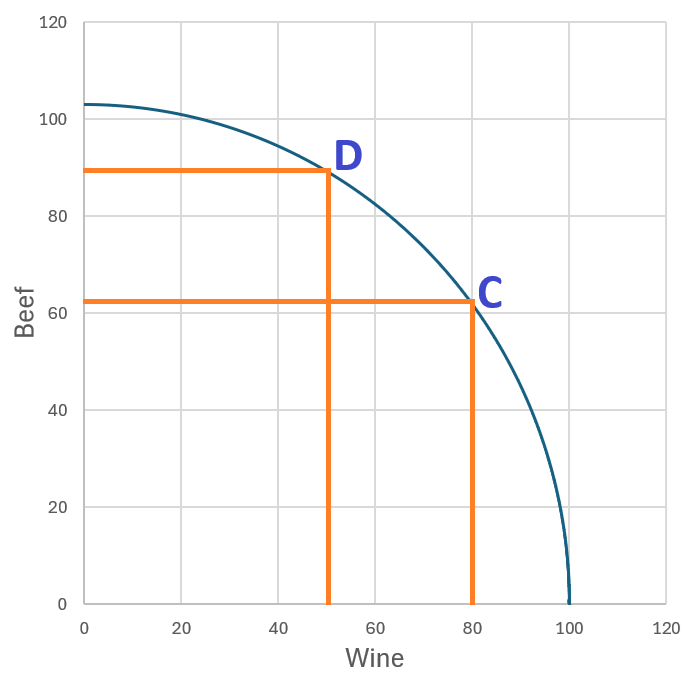
© State of Victoria (DE) Virtual School Victoria 2026. Normally, the PPF shows the production of two goods; in this example, those goods are beef and wine. Maximum production: 103 units of beef or 100 units of wine. Opportunity cost: Switching between goods means giving up some of one to make more of the other. E.g., moving from all beef to all wine costs 103 units of beef. Combining goods:
Efficiency: Using all resources in the best way, with no waste, to get the most output of both goods. Somewhere inside the curve = resources not fully used Watch the below video on PPF, opportunity cost and trade-offs, pausing to answer the questions as you go. |