Holocene Climatic Optimum
|
The Holocene is the era that came after the Pleistocene, approximately 12,000 years ago, and is considered to be the start of the present warm phase. The Holocene Climatic Optimum (HCO) or Holocene Optimum occurred between 8000 and 4000 years ago. However, changes and the rate of change varied between different regions. Many regions experienced warmer and, in some areas, moister conditions. Rising temperatures contributed to the continued melting of ice sheets, but because of their size, it took more than 2000 years for melting ice sheets to disappear. The Saharan and Arabian deserts almost disappeared and forests extended further towards the poles. |
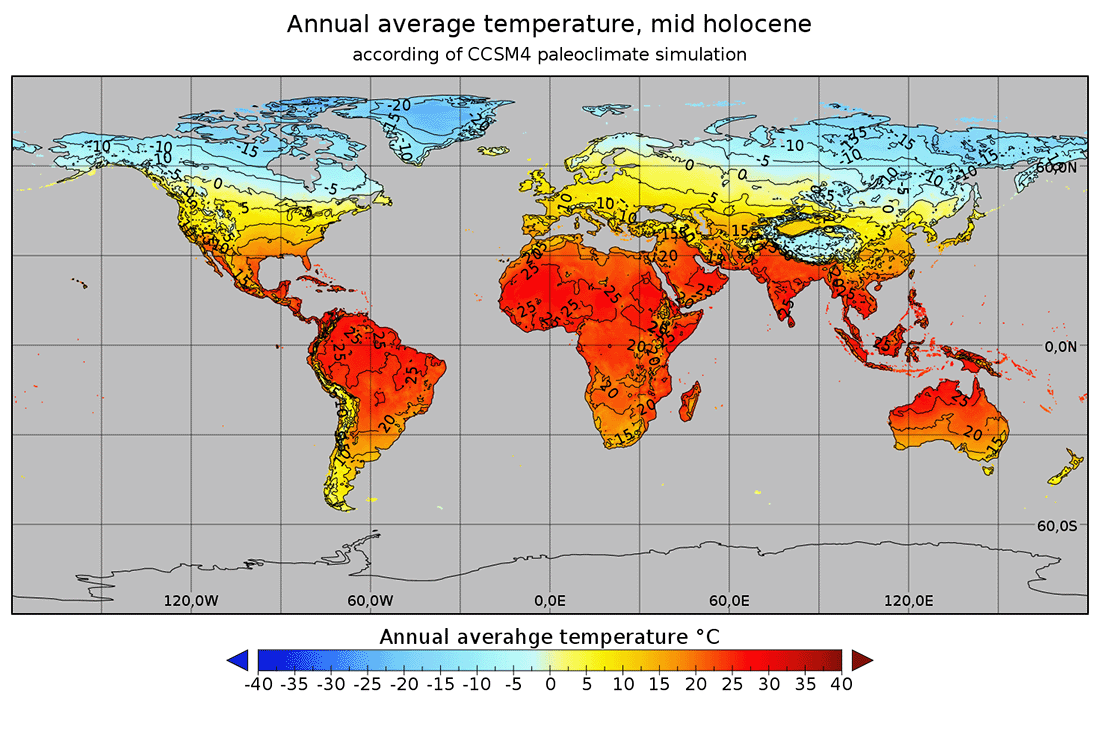
Merikanto (CC BY-SA 4.0). Accessed 9 September 2026. |
Text description of mapThe map shows simulated annual average temperatures during the mid-Holocene, approximately 6000 years ago. Temperatures are shown using a colour scale from below −40 °C to above 35 °C. The warmest average temperatures occur across tropical and subtropical regions of Africa, South America, southern Asia and northern Australia. Cooler temperatures occur towards the poles, with the lowest temperatures across Greenland, Antarctica and other high-latitude regions. The map demonstrates that climate conditions varied considerably between different parts of the world during the mid-Holocene. |