KGC: Movement
Applying movement
|
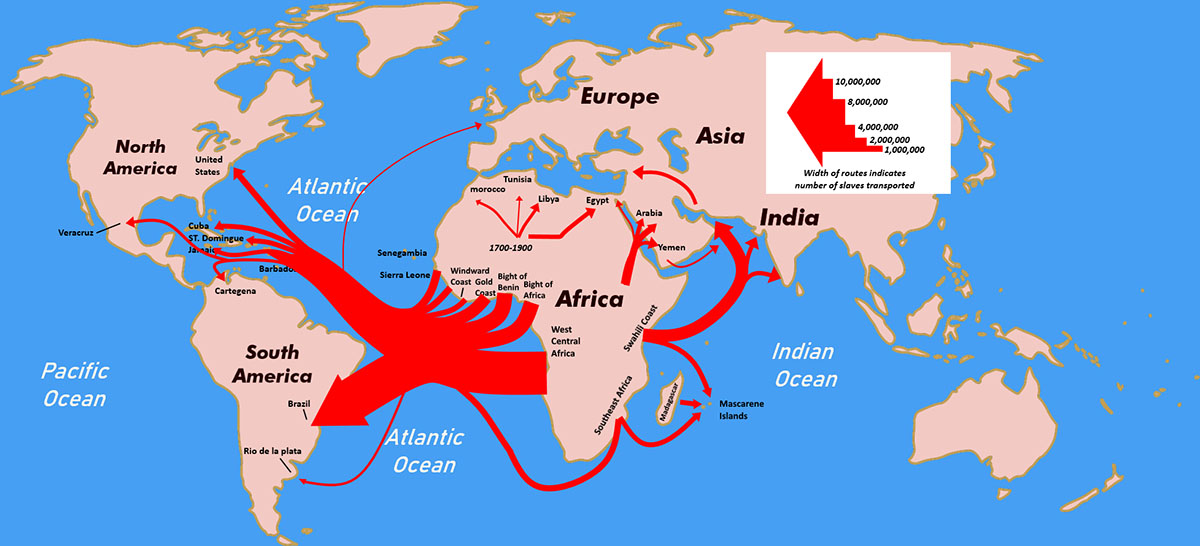
Consider the following map, which shows the movement of enslaved people from Africa to the Americas, then complete the task below. |
KuroNekoNiyah (CC BY-SA 4.0). Accessed 8 September 2026. |
Text version of mapThis map provides an overview of routes used in the trade of enslaved African people between 1500 and 1900. Africa is shown in the centre of the map, with the Americas to the west, Europe to the north, and Asia and the Indian Ocean to the east. How to read the map
African regions shown on the map The following regions associated with the trade are labelled along the western and central African coast, from north to south:
The map also labels Southeast Africa and the Swahili Coast on the eastern side of Africa. Routes from Africa to the Americas Red arrows leave several regions on the western and central coast of Africa and cross the Atlantic Ocean towards the Americas. The map shows routes to destinations in North America, the Caribbean, Central America, and South America. The following destinations in the Americas are labelled: North America, Central America and the Caribbean:
South America:
Several routes branch towards the Caribbean and nearby mainland destinations. A particularly wide route crosses the South Atlantic towards Brazil. Other routes extend farther north towards the Caribbean and North America and farther south towards the Río de la Plata region. Other routes shown on the map The map also shows the movement of enslaved people from Africa to destinations outside the Americas. These routes provide wider context for the African slave trade but are not the main focus of the activity. Europe and northern Africa
Arabia, Asia and the Indian Ocean
Routes from eastern Africa extend across the Red Sea and Indian Ocean towards Arabia, Yemen, India, Madagascar and the Mascarene Islands. Geographical features shown The map labels North America, South America, Europe, Africa and Asia. It also labels the Atlantic, Pacific, and Indian Oceans to help show the direction and distance of the routes. |