Causes of climate change

Cause #3: Agriculture and food systems
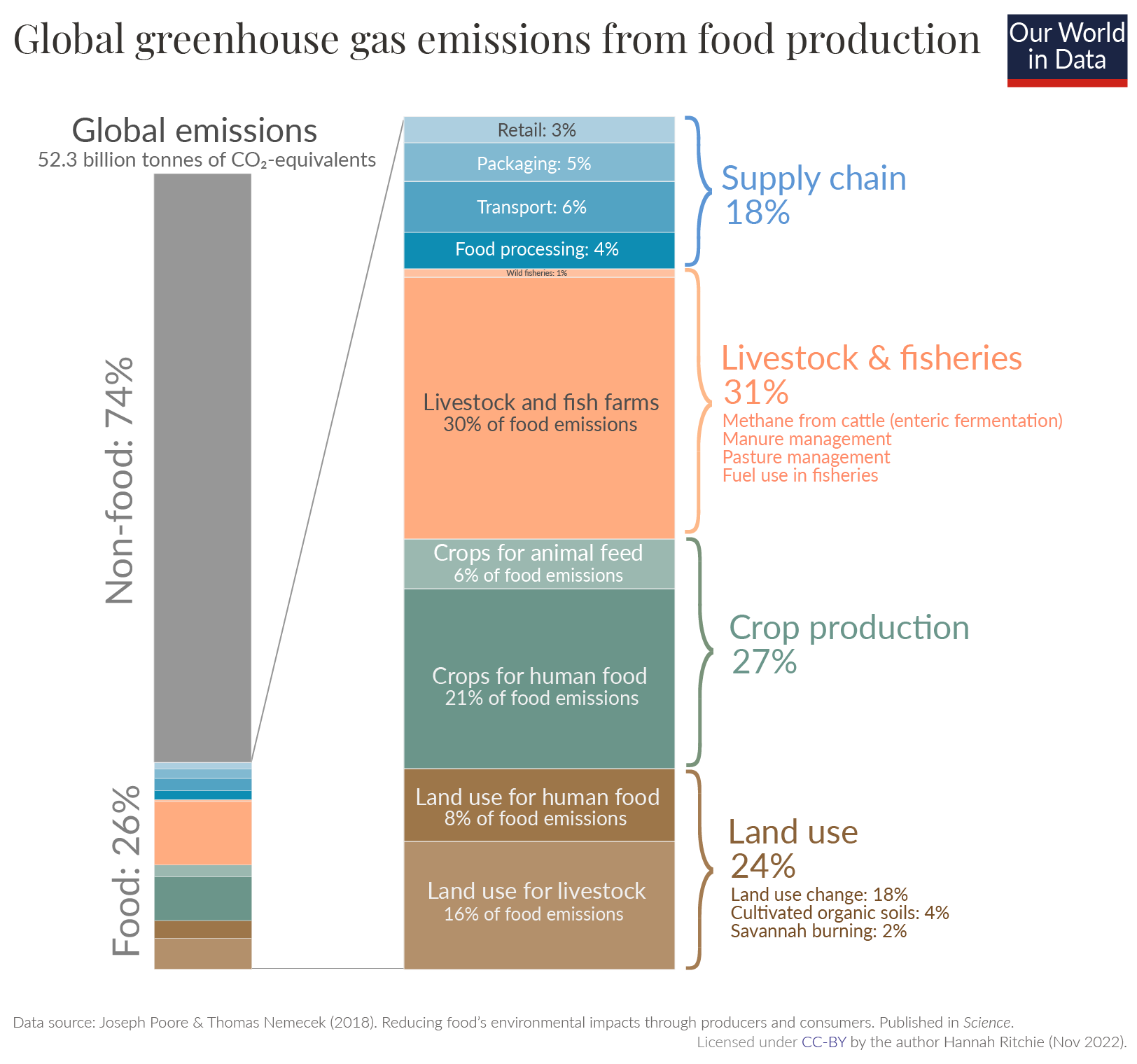
A bar chart illustrating global greenhouse gas emissions from food production. The graphic indicates total global emissions as 52.3 billion tonnes of CO₂-equivalents, with 74% attributed to non-food sources and 26% to food sources. Key categories of food emissions are displayed:

- Livestock and fisheries contribute 31%, with specific sources including methane from cattle, manure management, pasture management, and fuel use in fisheries.
- Crop production accounts for 27% of emissions.
- Land use related to food accounts for 24%, distinguished further into 18% from land use change, 4% from cultivated organic soils, and 2% from savannah burning.
- Crops for human food represent 21% and crops for animal feed contribute 6% of food emissions.
- Additional supply chain components include retail (3%), packaging (5%), transport (6%), and food processing (4%). Wild fisheries account for 1%.

The data source is attributed to Joseph Poore and Thomas Nemecek (2018), published in Science, and licensed under CC-BY by the author Hannah Ritchie (November 2022).

Hannah Ritchie (CC BY 4.0). Accessed 28 August 2026.

Agriculture and food systems are responsible for approximately a quarter (26%) of global greenhouse emissions (Poore and Nemecek, 2018). They emit large amounts of greenhouse gases at multiple stages the manufacture and supply chain. According to the UN Food and Agriculture Organization, agriculture (animals and crops) and processing accounts for approximately 30% of human caused emissions globally. Agriculture and systems for producing food releases carbon dioxide, methane, and nitrous oxide from farm activities and the conversion of forests to farmland. Methane from livestock digestion and rice cultivation, and nitrous oxide from fertiliser use and manure management are especially significant because they trap heat even more effectively than CO2, and become long-stored emissions in the atmosphere. Unless food systems are transformed as to their environmental impact, these emissions are expected to grow with increasing demand for food as global population peaks somewhere between 2080 and 2100, according to UN modelling.

Note taking: Agriculture and food systems
  1. Navigate to Oxford University's ‘Our World In Data’ page on Environmental Impacts of Food Production (2025).
  2. Read and take notes, particularly specific examples and facts you can use to explain agriculture as a cause of climate change.
  3. Answer the following in your notes:
    1. Explain why livestock farming has a higher climate impact than most plant-based foods, using one specific example (e.g. beef).
    2. How much of the earth’s habitable land is used for agriculture, and how does this contributes to climate change?
    3. Outline why what humans eat has more causal impact on climate change than the distance the food has travelled.
    4. How do agriculture and food systems contribute to climate change? Include a specific example / fact demonstrating the knowledge.