What is climate change?
|
Climate change refers to long-term shifts in the earth's temperature and weather patterns. Since earth's formation over 4.5 billion years ago, changes in the planet's temperature and weather patterns have been triggered largely by natural phenomena. However, since has early as the 1960s scientists have been warning that human activity was a contributing factor - indeed the leading contributor - to the period of rapid climate change we are living in today. This change is too fast and significant in scale to be attributed to natural variation alone, and began during the Industrial Revolution. This concept of human-driven climate change is also called anthropogenic ('anthrop' meaning related to humans, and 'genic' meaning produced by). Evidence over the decades since scientists' first warnings has increasingly confirmed that humans have created and accelerated the processes that shape the changing climate. (Adapted from Heywood, A., & Whitham, B. (2023). Global politics (3rd ed.). Bloomsbury Academic. Since the industrial revolution, humans have burnt fossil fuels that have released greenhouse gases into the earth's atmosphere. The four key greenhouse gases are carbon dioxide, methane, nitrous oxide, and chlorofluorocarbons. 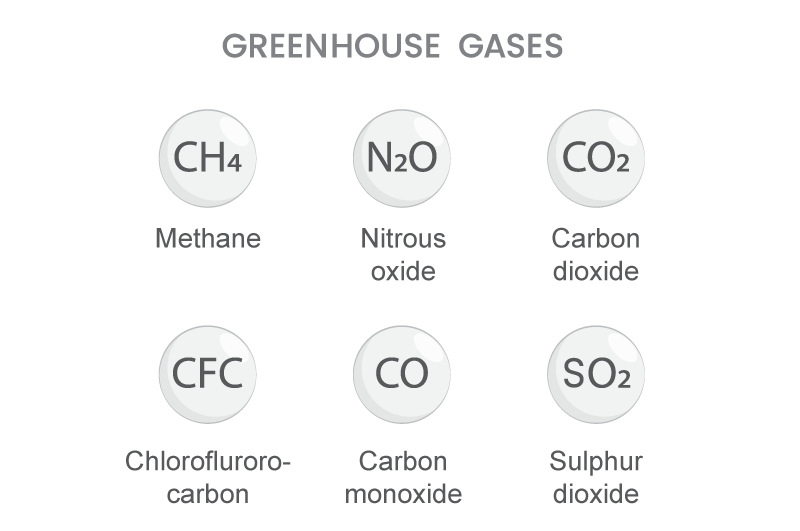
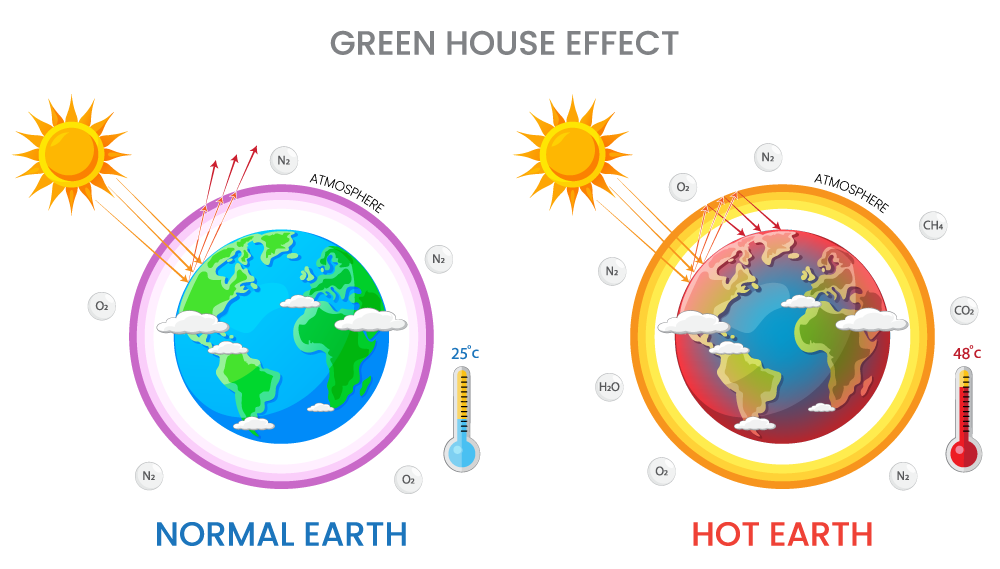
Adapted from Papia Majumder / Shutterstock.com Greenhouse gases thicken the earth's atmosphere, trapping the sun's heat close to the earth's surface and causing average temperatures to rise. This is known as the greenhouse effect, illustrated in the diagram below, and leads to climate change. |
Adapted from Papia Majumder / Shutterstock.com |