Analysing representations
Batman’s treaty
|
Have a look at the representation below of Wurundjeri Elders and John Batman (one of Melbourne's founders) on the banks of the Merri Creek in Northcote, Victoria. In the image, Aboriginal leaders sign a 'treaty' with John Batman. 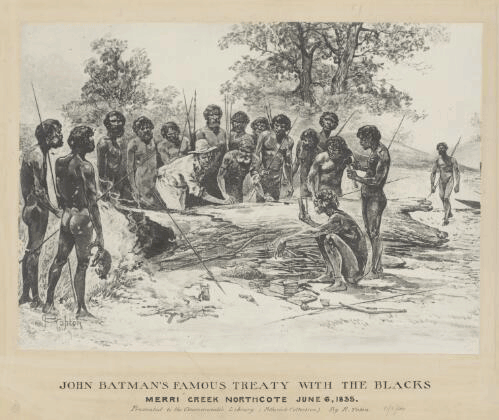
Ashton, George Rossi. (1914). John Batman's famous treaty, Merri Creek, Northcote, 6 June 1835. Retrieved 16 September 2026, from http://nla.gov.au/nla.obj-135926506, public domain. In the 1830s, Batman approached Indigenous Elders to purchase their land, which just so happened to be prime farming land. This act was unusual, as it was the first time that a European had approached Indigenous Australians directly to negotiate the occupation of their land. Claims that Batman and the Indigenous inhabitants of the land reached a treaty have been disputed, given Indigenous Australians' deep cultural connection to country. In Aboriginal culture, land is not seen as a possession that you can buy and sell (like a house, for example). Instead, land is deeply connected to belonging. The Western notion of owning property and exchanging legal contracts was unknown to First Nations communities in Australia. At the time, there were also issues of language. Batman brought with him Aboriginal ‘translators’ from Parramatta in Sydney and some historians claim that these two Aboriginal groups would not actually have been able to understand each other, given they spoke different languages. Historians now believe that there may have been confusion about what the treaty actually signified, and that some of the community members may have believed that it was granting temporary access to the land as part of a gift exchange. In August 1835 the Governor of New South Wales, Richard Bourke, declared the treaty void. This was because Batman had attempted to negotiate directly with the Indigenous community, and – as we’ll cover in more detail soon – the British did not recognise First Nations peoples as having any claim to the land of Australia. |