Factors that influence design
One factor: Aesthetics
Factor: AestheticsAesthetics is one of the Product Design and Technologies factors, and it is about beauty and how we perceive it. It includes consideration of design elements and design principles. You will be working with these in Weeks 3, 5 and 6 when creating your design concepts; however, you can also consider them in your Submission Task this week. You will also use them in analysing one product and how it addresses them. Let's learn a little bit about these visual tools, the design elements and design principles, now before you start designing in Week 3. Design elementsThese are the building blocks of all visual design disciplines. They are used in combination with each other to create and communicate ideas. Design elements include: point, line, shape, form, colour (tone, transparency, translucency, opacity) and texture. See below. Point
© State of Victoria (DE) Virtual School Victoria 2026 Point is the most basic element of design – a point is used to mark a point or spot. It can be tiny or large and different colours. It can be a line of points to emphasise an edge, or points can be placed randomly in a design. Line
© State of Victoria (DE) Virtual School Victoria 2026 A line is a mark between two points and is the building block for shape and form. It can be thin, thick, straight, curvy or jagged, and it can also be of different colours. It can run alongside an edge for visual interest. Shape
© State of Victoria (DE) Virtual School Victoria 2026 A shape is a two-dimensional area that is indicated by one or more lines joining up, i.e. to enclose a space. The two dimensions of a shape are its height and width, and it can be geometric, organic, abstract, simple or complicated. It has one surface or plane only. It can be outlined in colour, or it can be 'coloured in'. Form
© State of Victoria (DE) Virtual School Victoria 2026 Form is three-dimensional – in addition to height and width, it also has thickness (or depth). Form has three or more surfaces or planes. For example, a cylinder has three planes: a top, bottom and side. A cube and a prism (rectangular block) both have six planes: a top, bottom and four sides. Forms can be geometric (as seen above) or organic. They can be bulky or skeletal. Colour
Adapted from Zidas Raudan / Shutterstock.com Colour is applied to the other elements and is employed in a variety of uses – to create mood (warm, cold, happy, scary etc.), emphasis, balance, hierarchy, etc. You can read more here on these colour terms: saturation, value and hue. In this study you need to know:
Texture
Adapted from F Armstrong Photography, Kwangmoozaa, Sontenn / Shutterstock.com Texture is the properties of a material's surface, how it feels – it can be smooth, soft, rough, furry, shiny, etc. It is visually represented using other elements of design. On screen or paper, it can create a tactile or realistic look. Design principlesThese are the tools with which we manipulate (arrange, combine and organise) the design elements. They can be used in the creative process to extend, change, improve ideas and can be used as guidelines to create a specific style. For example: a repeating pattern of red and pink geometric shapes; or an autumn colour theme in an asymmetrical manner; or big, bold, bright colours in an organic pattern. Principles of design include: BalanceBalance refers to the sense of harmony between various visual elements. Balance can be achieved with many of the other design principles, such as by using either symmetrical or asymmetrical design. Contrast
Adapted from Katerina Maksymenko, SanjuBhandari / Shutterstock.com Contrast is when very different colours or textures are placed close to each other to provide clarity or visual interest. Shiny metal and furry fabric above. RepetitionRepetition is the use and reuse of one or more elements in a visual composition. It is different from pattern in the sense that repetition does not require a consistent format – it can be irregular and uneven. For example, simply repeating a particular curved line or shape throughout a design. 
Adapted from Elynikie / Shutterstock.com The feeling of movement and / or rhythm can be created by a combination and repetition of design elements and other design principles to create a sense of motion, such as lines, shapes, colours, and asymmetry in an object. Pattern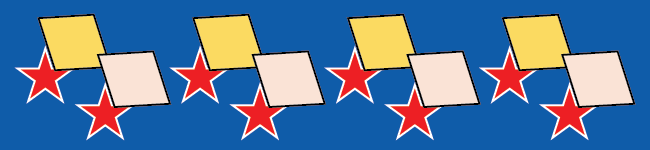
© State of Victoria (DE) Virtual School Victoria 2026 Pattern is the repetition of one or more elements, such as colour and shape that are arranged in a consistent format. Proportion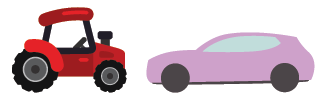
La lamul, Peekadillie 34 / Shutterstock.com Proportion is the relationship of scale between parts of a product. It can be unbalanced, exaggerated or harmonious and is used to create a new look or a product of visual interest. It is how an object is separated into parts, such as large wheels on the tractor image and tiny high windows on the car. Asymmetry or symmetry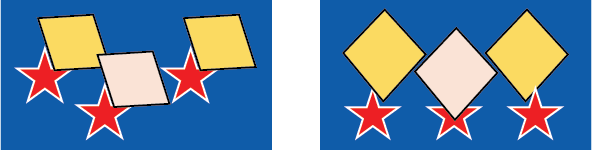
© State of Victoria (DE) Virtual School Victoria 2026 Asymmetry or symmetry is whether a piece has very different sides (asymmetrical – see image at left above) or whether the sides are identical like a mirror image (symmetrical – see image at right above). Balance can be achieved by either. Negative and positive
Adapted from Anconer Design, johavel, stokdigital4 / Shutterstock.com Negative and positive space refers to the parts of a product that can be touched (positive space) or the spaces in between the parts that do not exist or consist of air (negative space). In the image above, observe the negative space (which is the same colour as the background) created by the kettle handle, lid and knob; the holes in the button; and the space between the nose rim of the glasses as well as under the ear hooks of the arms. Surface quality
Adapted from PK Cameraman, Virrage Images / Shutterstock.com Surface quality is a term that is similar to the design element of texture but can also refer to undulating or uneven levels of a surface, corrugations, pitted surfaces or created by irregular interlocking pieces such as tiles. Notice that in describing some of the elements and principles, it often includes the names of other elements or principles. |