Narration, dialogue and sound effects
|
As well as depicting the things that we can typically see – people, settings and events – comics use a range of written words to represent what is heard. These take the form of speech and sound effects. Generally, what is ‘said’ in a comic book takes two forms: narration and speech. Narration is usually placed in a box, while speech is usually shown in a bubble. You can see both narration and dialogue in the images below, from the graphic novel adaptation of To Kill a Mockingbird, which was adapted and illustrated by Fred Fordham. 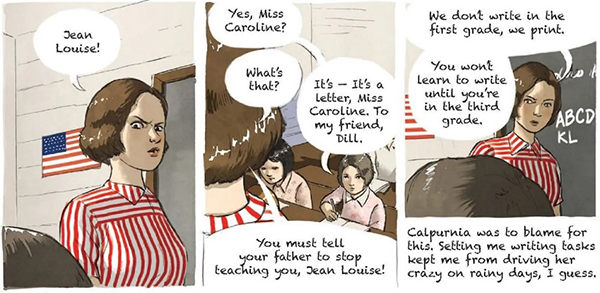
Copied under s113p. Harper Lee, adapted and illustrated by Fred Fordham, To Kill a Mockingbird: A Graphic Novel, William Heinemann/Random House, 2018, ISBN 9781785151552 Other sounds that take place in the world of the comic can be shown in many ways (and therefore ‘sound’ different in your imagination) depending upon their font, size, and the appearance of motion. A good example is shown below, by master comic book storyteller Wally Wood. It comes from a short story called Sound Effects in MAD Magazine. 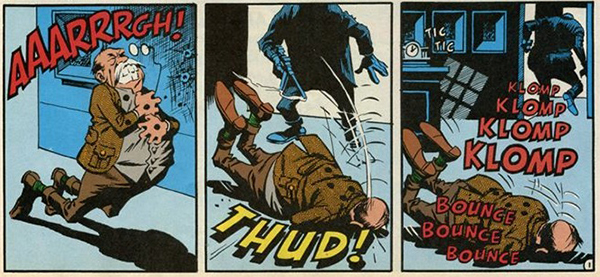
Copied under s113p. Harvey Kurtzman (writer) and Wally Wood (artist), “Sound Effects!”, MAD #20, EC Comics, February 1955. |