Lesson 4

Angle and the gradient

Using our knowledge of right-angled triangle trigonometry, we can see that the angle that the line makes with the positive direction of the x-axis is related to the gradient.
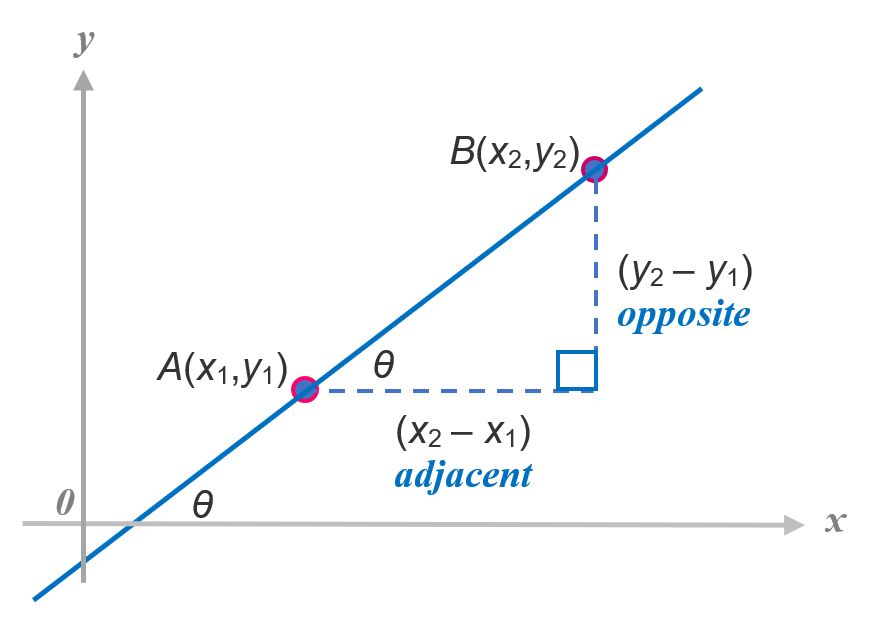
Diagram 1

© State of Victoria (DE) Virtual School Victoria, made with GeoGebra®.

\( \textrm{tan} \ \theta = \displaystyle\frac{opposite}{adjacent} = \displaystyle\frac{y_2-y_1}{x_2-x_1} = m = gradient \)

\( m = \textrm{tan} \ \theta \)

The gradient \( m \) is equal to \( \textrm{tan} \ \theta \), where \( \theta \) is the angle between the line and the positive direction of the \( x \) axis.

If \( m \) is positive \( \theta \) is acute. If \( m \) is negative \( \theta \) is obtuse.
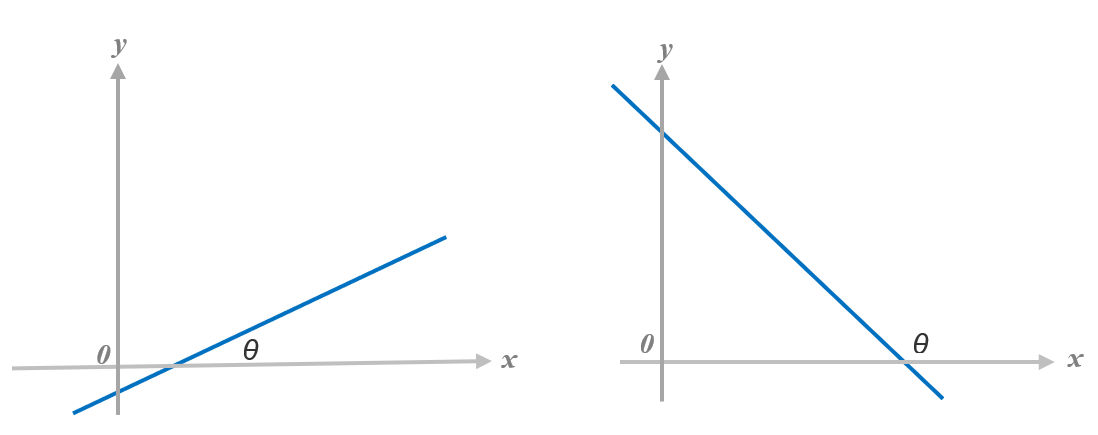
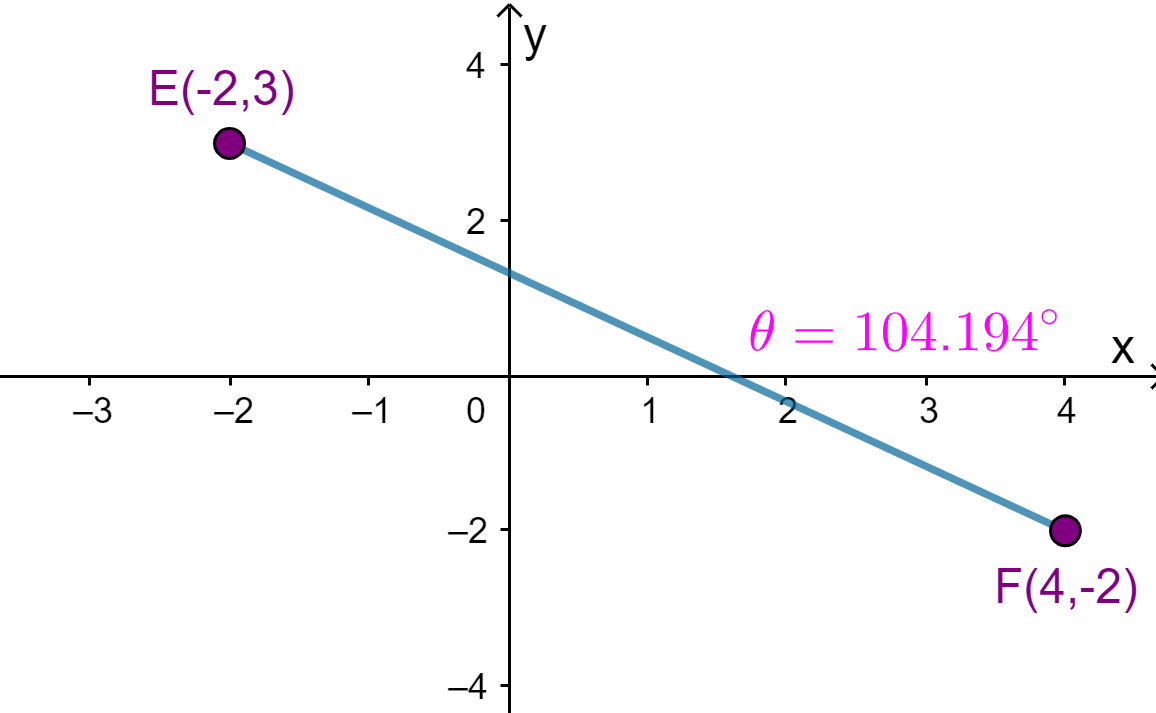
Diagram 2

© State of Victoria (DE) Virtual School Victoria, made with GeoGebra®.

Example 13

Find the angle that each line passing through the following points makes with the positive direction of the x-axis.

(a)

\( (−3, \ −4) \) and \( (2, \ 5) \)

Written Solution

\( x_1=-3, \ y_1=-4, \ x_2=2, \ y_2=5 \)

\( \begin{eqnarray} m &=& \displaystyle\frac{y_2-y_1}{x_2-x_1} \\ \\ m &=& \displaystyle\frac{5- -4}{2- -3} \\ \\ &=& \displaystyle\frac{9}{5} \end{eqnarray} \)

So

\( \begin{eqnarray} \textrm{tan} \ \theta &=& \displaystyle\frac{9}{5} = 1.8 \\ \theta &=& \textrm{tan}^{-1} \biggl( \displaystyle\frac{9}{5} \biggr) = \textrm{tan}^{-1} = (1.8) \\ \theta &=& 60.9^{\circ} \ \textrm{to one decimal place} \end{eqnarray} \)

Diagram 3

© State of Victoria (DE) Virtual School Victoria, made with GeoGebra®.

(b)

\( (4, \ −2) \) and \( (−2, \ 3) \)

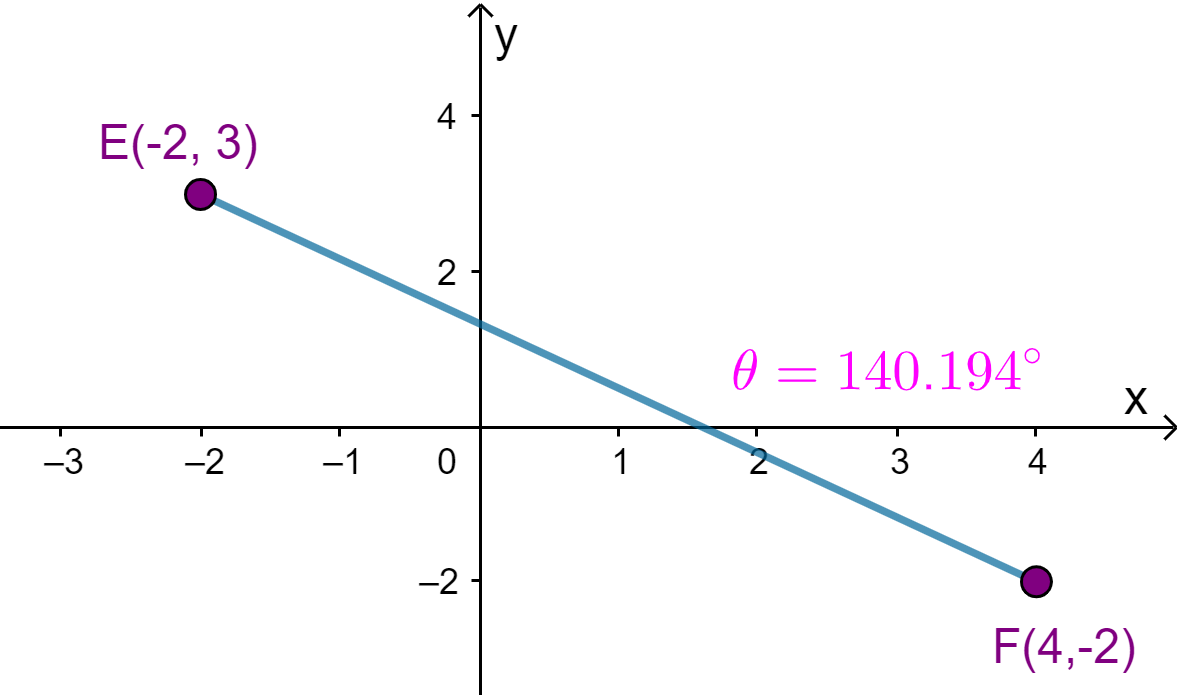
Written Solution

\( x_1=-2, \ y_1=3, \ x_2=4, \ y_2=-2 \)

\( \begin{eqnarray} m &=& \displaystyle\frac{y_2-y_1}{x_2-x_1} \\ \\ m &=& \displaystyle\frac{-2-3}{4--2} \\ \\ m &=& \displaystyle\frac{-5}{6} \end{eqnarray} \)

So

\( \begin{eqnarray} \textrm{tan} \ \theta &=& - \displaystyle\frac{5}{6} \\ \theta &=& \textrm{tan}^{-1} \biggl(- \displaystyle\frac{5}{6} \biggr) \\ \theta &=& -39.806^{\circ} \ (\textrm{to three decimal places}) \end{eqnarray} \)

The angle that the line makes with the positive direction of the x-axis can be found by subtracting the magnitude of the acute angle from 180°. In other words disregard the sign and subtract from 180°

\( 180 - 39.806 = 140.194^{\circ} \ \textrm{to three decimal places} \)

Diagram 4

© State of Victoria (DE) Virtual School Victoria, made with GeoGebra®.

CAS Solution

TI-Nspire

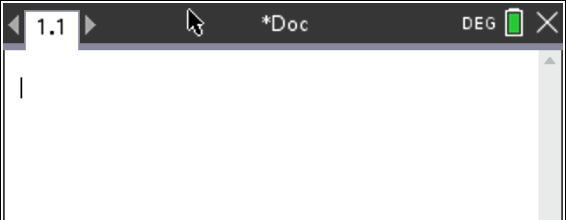
Mode settings are located at the top right of the screen.

Tap to change the settings to deg.

Press the trig key to access the mini-palette.

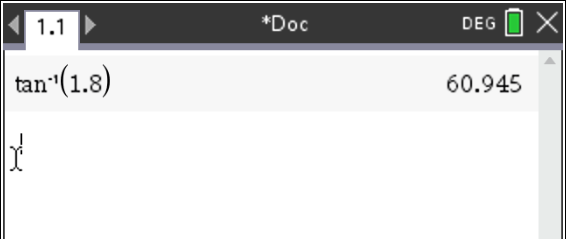
Input \( \textrm{tan}^{-1} (1.8) \) and press enter.

Repeat the same process for (b).

Diagram 5
Diagram 6
Casio ClassPad

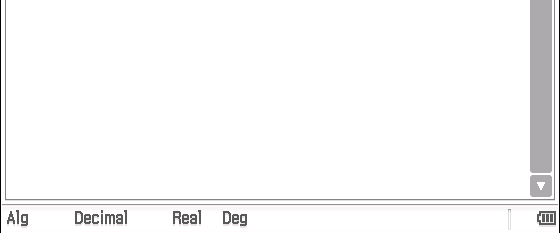
Mode settings are located at the bottom of the screen. The default modes are Standard and Rad.

Tap to change the settings to Decimal and Deg.

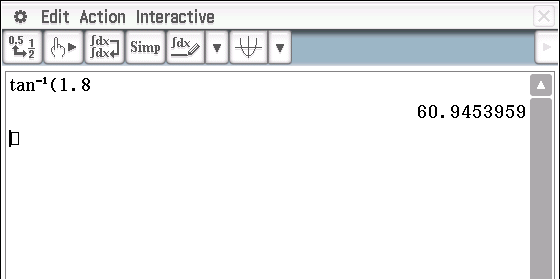
Open the Keyboard and tap Trig to access the trigonometry functions and symbols.

Input \( \textrm{tan}^{-1} (1.8) \) and tap EXE.

Repeat the same process for (b).

Diagram 7
Diagram 8

CAS Calculator screenshots © State of Victoria (DE) Virtual School Victoria 2026