Lesson 2
Simultaneous equations
|
Below are two linear equations: \( x+y=4 \)
These form a system of linear equations. There are many ordered pairs that satisfy the equation \( x+y=4 \). For example (0, 4), (1, 3), (1.2, 2.8) are all possible solutions for \( x \) and \( y \). There are many ordered pairs that satisfy the equation \( x-y=5 \). For example (6, 1), (4, -1), (7.3, 2.3) are all possible solutions for \( x \) and \( y \). But there is only one ordered pair that satisfies both equations, (4.5, −0.5). If the equations are graphed then the point of intersection gives the solution. 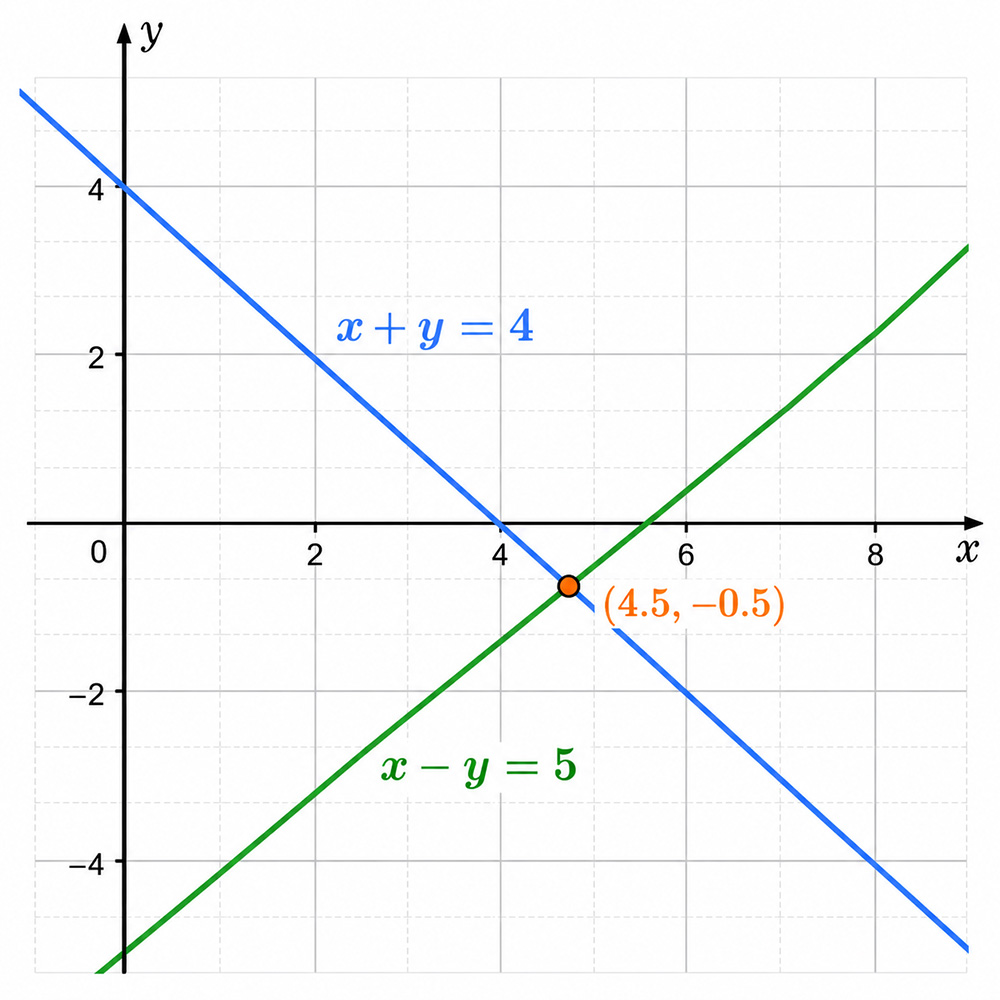
Image generated with ChatGPT, GPT-5.6 Sol, 11 September 2026. To find the values of \( x \) and \( y \) which satisfy both equations, we can solve the linear equations algebraically. In this lesson we will look at two algebraic methods for solving a pair of simultaneous equations:
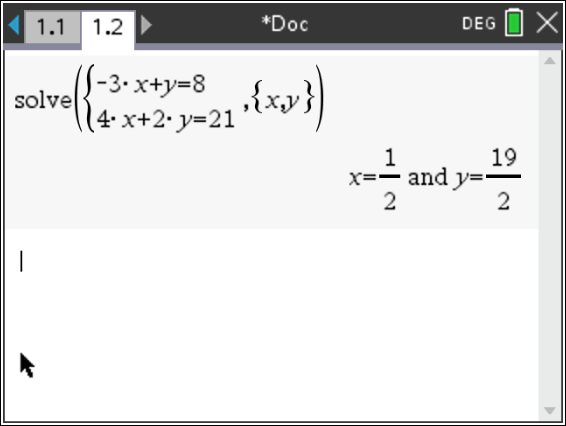
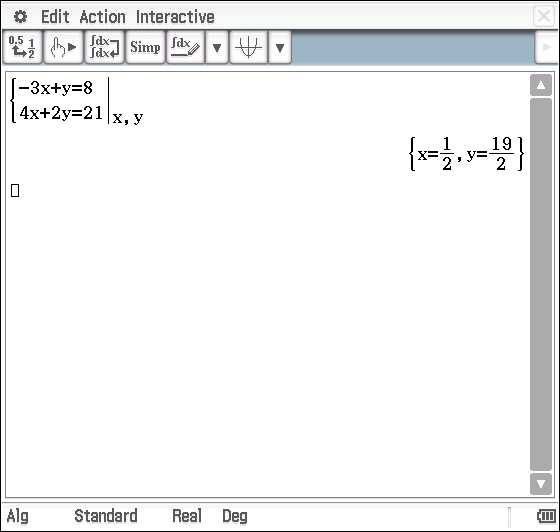
CAS Calculator screenshots © State of Victoria (DE) Virtual School Victoria 2026 |
||||||||||||