Hypotheses and variables
Writing a hypothesis
|
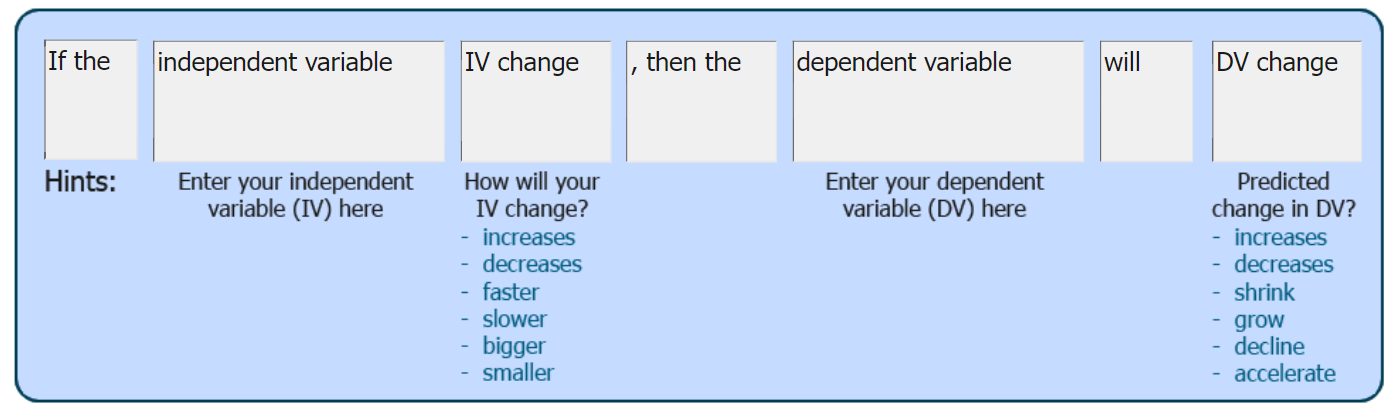
Writing a hypothesis is a skill that needs to be practised. Luckily, you'll get a lot of chances to practise in this course! In VCE Biology, we encourage you to use the if-then structure when writing hypotheses: If-then hypotheses Here's the process you should use to write a hypothesis. How to write a hypothesisThe following six-step process provides an example of how a hypothesis may be constructed from a research question using an 'if-then' method: Step 1: Ask a research question of interest. Step 2: Identify the independent variable (IV). Step 3: Decide how the IV will be changed in the experiment. Example: Number of daylight hours will be increased. Step 4: Identify the dependent variable (DV). Step 5: Predict how changing the IV will affect the DV. Step 6: Construct a hypothesis using the if-then structure. Adapted from: VCAA (2015) VCE Biology Units 1 and 2: 2016–2020: Advice for teachers, Victorian Curriculum and Assessment Authority, p. 23. |
© State of Victoria (DE) Virtual School Victoria 2026. |