The proteome
|
As you've already learned, proteins are responsible for almost everything in the body. They are made via the process of transcription and translation producing the primary protein structure (linear sequence of amino acids). This primary structure undergoes folding into secondary, tertiary and sometimes quaternary structures in the endoplasmic reticulum as it goes through the protein secretory pathway. The final result is a complete set of proteins produced by a cell or organism needed to maintain life. This is the proteome. The proteome is incredibly diverse. Here are a few key types of proteins and what they do:
Proteins are vital for life, with the human body containing over 100,000 different proteins, each with specific roles (Genomics Education Programme, 2024). Despite this diversity, humans have fewer than 20,000 protein-coding genes (Amaral et al., 2023). This is possibly due to a process called alternative splicing, where a single gene can produce multiple proteins. After a gene is copied into pre-mRNA (during transcription), sections of the pre-mRNA (exons) can be rearranged or removed, leading to different protein versions depending on how the splicing occurs. |
|
Draw the following diagram in your notes and annotate it with a description of how alternative splicing works. |
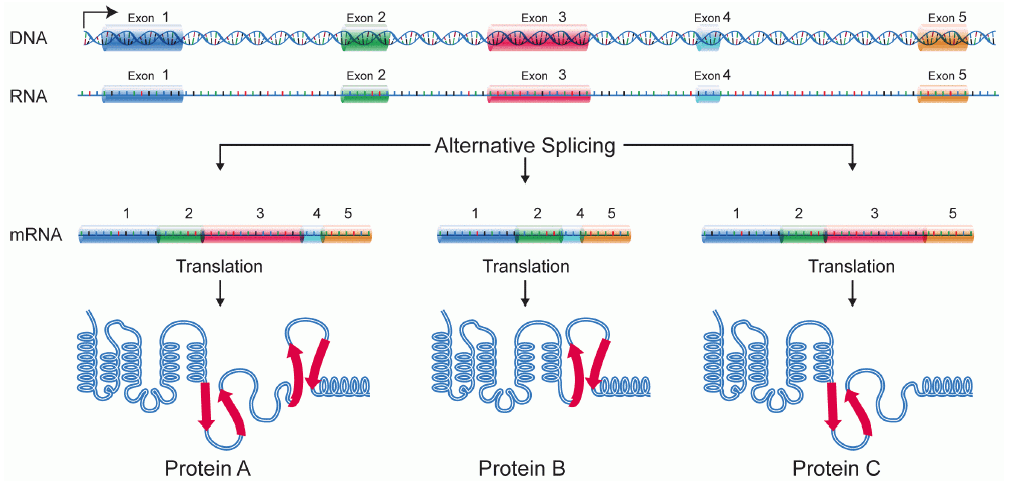
Alternative splicing by National Human Genome Research Institute, public domain. Accessed 31 August 2026. |
|
References |