Schrodinger and the quantum-mechanical model
Quantum numbers, atomic orbitals and electronic configuration
|
Next we will examine Schrodinger's model of subshells and orbitals more closely, and look at how to represent the electronic configuration of elements in the periodic table. The subshells are filled starting from the lowest energy, and the order followed is: \( 1s < 2s < 2p < 3s < 3p < 4s < 3d < 4p < \) The orbitals are filled as follows: \( 1{s}^{2} < 2{s}^{2} < 2{p}^{6} < 3{s}^{2} < 3{p}^{6} < 4{s}^{2} < 3{d}^{10} < 4{p}^{6} < \) Order of filling subshells (follow the arrows)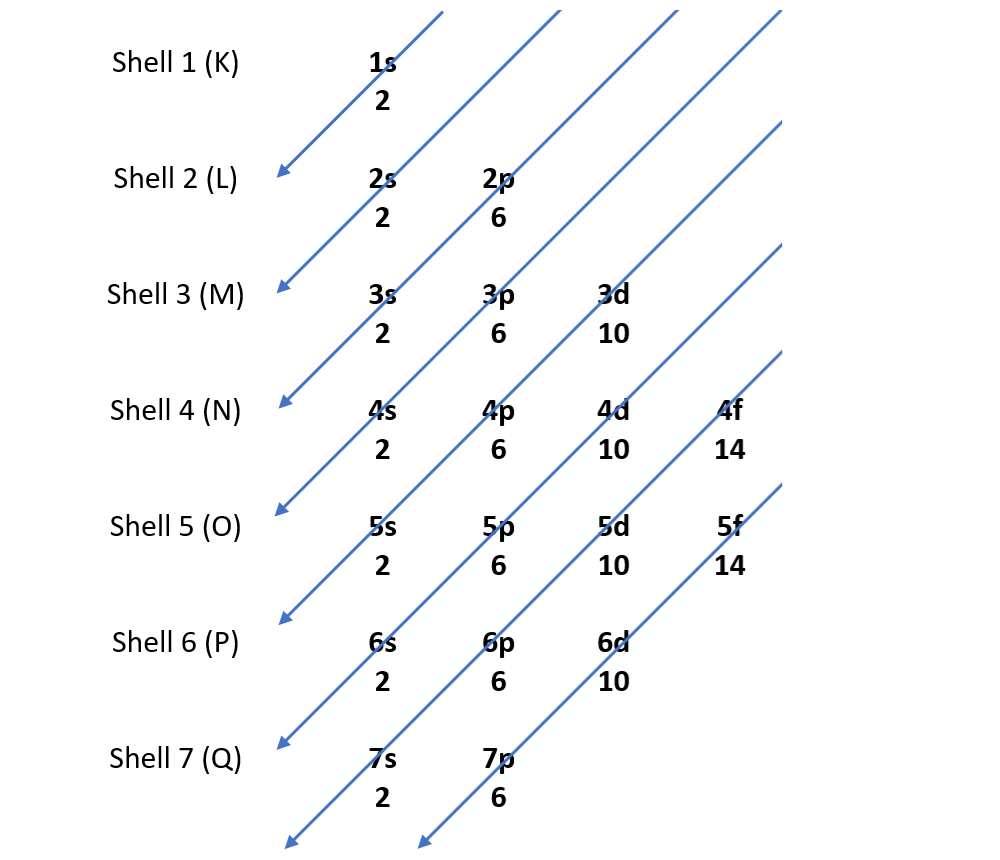
© State of Victoria (DE) Virtual School Victoria 2026. The pattern of filling subshells is: \( 1s \rightarrow 2s \rightarrow 2p \rightarrow 3s \rightarrow 3p \rightarrow 4s \rightarrow 3d \rightarrow 4p \rightarrow \) So, why is it that the electronic configuration for scandium is 2, 8, 9, 2 and not 2, 8, 8, 3, as would be the case if the Bohr model had been followed? Scandium has an atomic number of 21 and is one of the transition elements, which means its \( d \) subshell is being filled. If we apply the rules based on Schrodinger's work, the order of filling for scandium, is: \( 1{s}^{2} \) \( 2{s}^{2} \) \( 2{p}^{6} \) \( 3{s}^{2} \) \( 3{p}^{6} \) \( 4{s}^{2} \) \( 3{d}^{1} \) The \( 4s \) subshell has lower energy than the \( 3d \) subshell, so normally \( 4s \) fills before \( 3d \). The element zinc is also a transition metal, and it has an atomic number of 30. The electronic configuration using the subshell filling order is: \( 1{s}^{2} \) \( 2{s}^{2} \) \( 2{p}^{6} \) \( 3{s}^{2} \) \( 3{p}^{6} \) \( 3{d}^{10} \) \( 4{s}^{2} \) The \( 4s \) subshell has lower energy than the \( 3d \) subshell, so normally \( 4s \) fills before \( 3d \). However, if the \( 3d \) subshell can be half-filled or fully filled, then it is more stable than the \( 4s \) subshell. Therefore, the half-filled or fully-filled \( 3d \) subshell will fill before the \( 4s \) subshell. |