Schrodinger and the quantum-mechanical model
M shell and N shell
M shellThe third shell (M shell) has quantum number \( n = 3 \). The number of electrons \( = 2{n}^{2} = 2 \times 9 = 18 \). The M shell has 3 subshells, \( 3s \), \( 3p \) and \( 3d \). The \( 3s \) subshell holds 2 electrons \( 3{s}^{2} \). The \( 3p \) subshell holds the next 6 electrons \( 3{p}^{6} \). The \( 3d \) subshell holds the remaining 10 electrons \( 3{d}^{10} \). 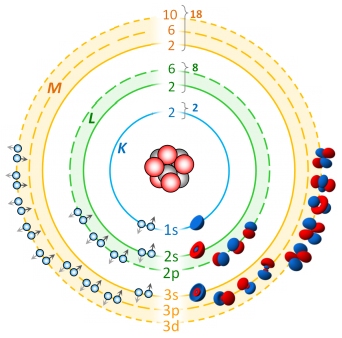
By S. Zurek, from Encyclopedia Magnetica: https://e-magnetica.pl/file/shell_subshell_orbital_iron_magnetica_png CC-BY-4.0: http://creativecommons.org/licenses/by/4.0/ N shellThe fourth shell (N shell) has quantum number \( n = 4 \). The number of electrons \( = 2{n}^{2} = 2 \times 16 = 32 \). The N shell has 4 subshells, \( 4s \), \( 4p \), \( 4d \) and \( 4f \). The \( 4s \) subshell holds 2 electrons \( 4{s}^{2} \). The \( 4p \) subshell holds the next 6 electrons \( 4{p}^{6} \). The \( 4d \) subshell holds the next 10 electrons \( 4{d}^{10} \). The \( 4f \) subshell holds the remaining 14 electrons \( 4{f}^{14} \). 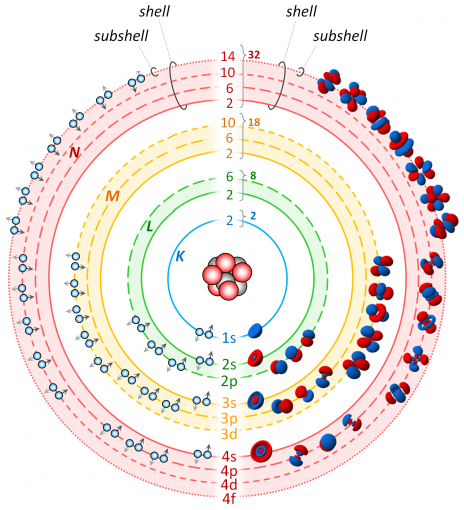
By S. Zurek, from Encyclopedia Magnetica: https://e-magnetica.pl/file/shell_subshell_orbital_iron_magnetica_png CC-BY-4.0: http://creativecommons.org/licenses/by/4.0/ |