Schrodinger and the quantum-mechanical model
|
Austrian physicist Erwin Schrodinger (1887−1961) refined the Bohr model of the atom in 1926. His model used a new quantum theory that described electrons as exhibiting both particle and wave behaviour. French scientist Louis de Broglie proposed this behaviour of electrons, based on the earlier work of Albert Einstein and Max Planck on quantum theory. 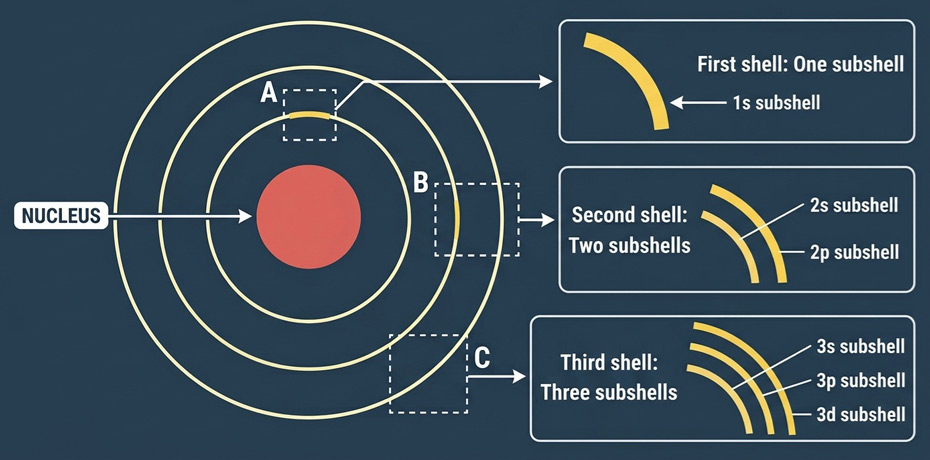
Image generated by Google Gemini, 10 September 2026. The diagram above represents a Period 3 element (i.e. an element in the third row of the periodic table). You can see there are three shells; these show the three energy levels, referred to as principal quantum numbers. In each shell, there are subshells, each with specific energy levels. The number of subshells in a shell corresponds to the principal quantum number; that is, the shell number. For the first shell \( n = 1 \), there is one subshell \( s \); for the second shell \( n = 2 \), there are two subshells, \( s \) and \( p \); and for the third shell \( n = 3 \), there are three subshells, \( s \), \( p \) and \( d \). Continuing this to the fourth shell \( n = 4 \), we would have four subshells, \( s \), \( p \), \( d \) and \( f \). Each subshell has orbitals, which are regions in which electrons move. The maximum number of electrons per orbital is two, consistent with the Pauli Exclusion Principle. On the following pages, we'll see what this looks like when represented in diagrams. |