Niels Bohr and the arrangement of electrons in shells
Examples of electronic configurations using Bohr's Model
Example 1: SodiumLet's consider the next element from the series listed in the table on the previous page: sodium (Na), which has an atomic number of 11. This means sodium has 11 electrons. To work out the electron configuration, we apply the rule for the maximum number of electrons in each of the shells.
The electronic configuration of sodium (Na) is 2, 8, 1. We show the electrons around the nucleus as in the diagram below. Apart from the inner shell, the electrons are arranged in pairs in each shell. 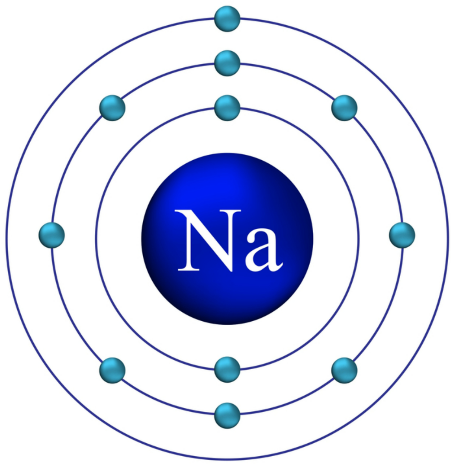
Atomic number = 11 Atomic mass = 22.989769 saran insawat / Shutterstock.com Example 2: PotassiumNext, let's work out the electronic configuration of potassium (K). Its atomic number (number of protons) is 19, which means it has 19 electrons.
The electronic configuration for potassium is 2, 8, 8, 1. We show the electrons around the nucleus as in the diagram below. Apart from the inner shell, the electrons are drawn in pairs in each shell. 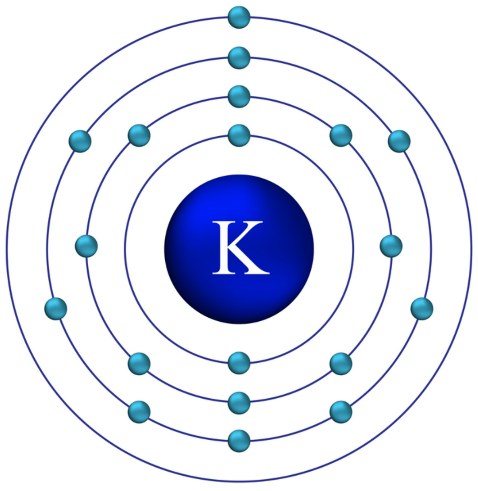
Atomic number = 19 Atomic mass = 39.0983 saran insawat / Shutterstock.com |
|
Have you noticed that both sodium and potassium have one electron in their outer shell? Take a look at the periodic table and see if you can explain what that means. The electron/s in the outermost shell of an atom are called valence electrons. Write this term in your notebook, along with the meaning. |