Niels Bohr and the arrangement of electrons in shells
Electron arrangements in atoms using Bohr's Model
|
Bohr's model of the atom showed electrons arranged in shells (orbits of fixed energy levels). In atomic models, electron shells are labelled K, L, M and N, starting with the shell closest to the nucleus. 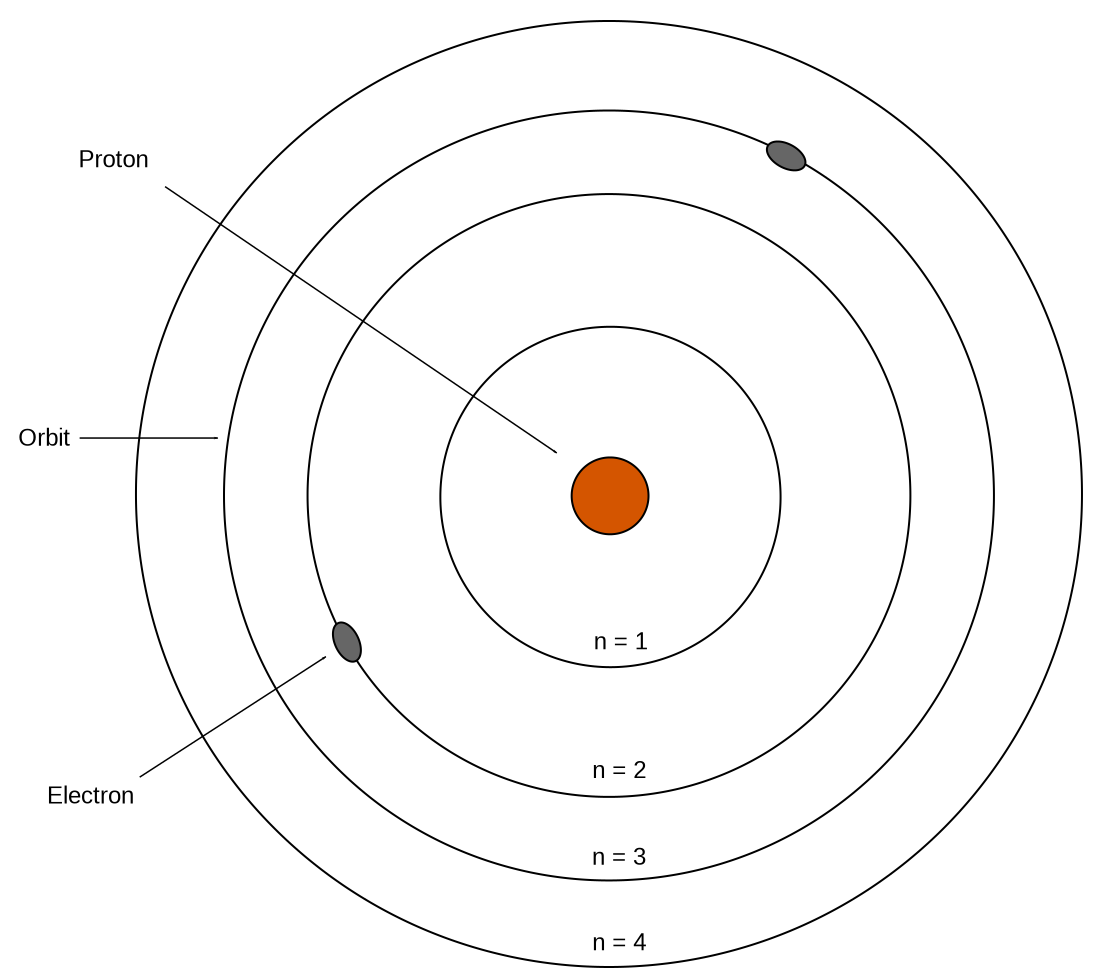
Sharon Bewick and Adrignola (Wikimedia Commons) (CC BY-SA 3.0). Accessed 10 September 2026. Each shell has a principal quantum number, \(n\), beginning with \(n = 1\) for the innermost shell. The maximum number of electrons that can occupy a shell is given by the formula \(2n^2\). The table below shows how many electrons can be occupied by each of the shells of fixed energy levels.
The table below shows this rule applied to the first 10 elements:
|