Isotopes and relative atomic mass of an element
Calculating relative atomic mass
|
A mass spectrometer is used to identify the isotopes of an element and their relative abundances.
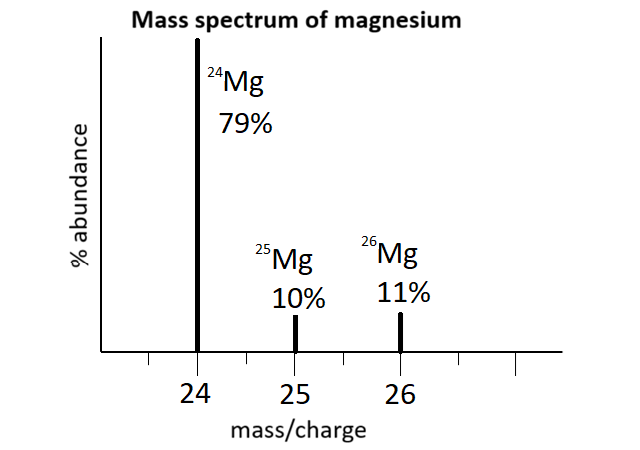
Adapted from UW-Madison Chemistry 103/104 Resource Book and crlandis (CC BY-NC-SA 4.0). Accessed 28 August 2026. The percentage abundance of an isotope tells us the proportion of atoms with a specific mass, found in a naturally occurring sample of an element. The relative atomic mass (Ar) of an element depends on how many stable isotopes there are, and the percentage abundance of those isotopes. To calculate the average atomic mass of an element, we multiply the atomic mass of each of the element's isotopes by their corresponding percentage abundance, and then take the sum of those values, to find the weighted average. The below equation uses chlorine as an example. \( {A}_{r} = \displaystyle\frac{\text{sum of isotope mass} \times \text{total isotope abundance}}{100} \) \( {A}_{r} = \displaystyle\frac{(75 \times 35)+(25 \times 37)}{100} = 35.5 \) The information from the mass spectrum for magnesium can be presented in a table, as shown below. The formula for calculating the proportion of each isotope of magnesium is shown in the right-hand column of the table. The sum of each proportion gives the relative atomic mass of magnesium.
|
||||||||||||||||||||