Isotopes
Chlorine isotopes
|
Let's look at chlorine as an example. Chlorine (Cl) has an atomic number of 17 and has many isotopes, but only two are stable: chlorine-35 and chlorine-37. Cl-35 has a mass number of 35 (17 protons and 18 neutrons) and Cl-37 has a mass number of 37 (17 protons and 20 neutrons). 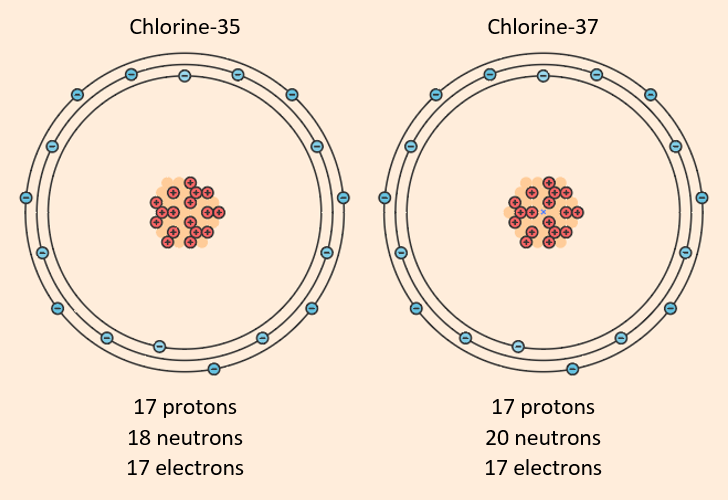
Adapted from Patricia F. Carvalho / Shutterstock.com Naturally occurring chlorine contains approximately 76% Cl-35 and 24% Cl-37. This means that, in a sample of 100 chlorine atoms, we would expect approximately 76 atoms to be Cl-35 and 24 to be Cl-37. Many elements occur naturally as mixtures of isotopes. We can use the relative isotopic masses and their abundances to calculate the relative atomic mass of an element. We can use the following formula to calculate the relative atomic mass of chlorine (the same formula can be used to find the relative atomic mass of any element with two stable isotopes). \( \begin{eqnarray} A_r=\frac{\textrm{(isotopic mass Cl-35)} \times \%\textrm{abundance} + \textrm{(isotopic mass Cl-37)} \times\ \% \textrm{abundance}} {\textrm{100}} \end{eqnarray} \)
In the periodic table, the relative atomic mass shown for each element has been calculated using the isotopic mass and abundance of each of its isotopes. Many elements have more than one stable isotope (although some have only one stable isotope and others have none). Watch the following video (2:50 mins) to learn more about isotopes and the relative atomic mass of elements: |