Isotopes
|
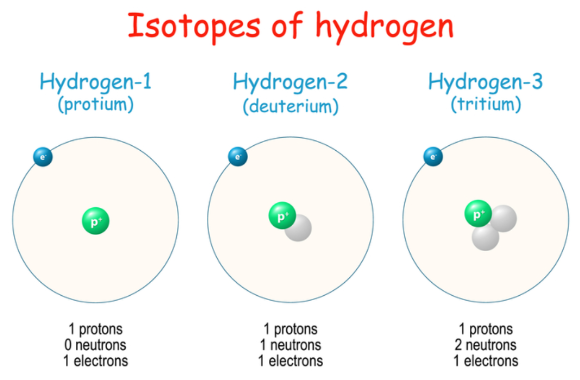
Isotopes are different versions of the same element. All isotopes of an element have the same number of protons and electrons, but each has a different number of neutrons. Remember, the mass number of an atom is the sum of the number of protons and neutrons in the nucleus. Importantly, neutrons have no charge. Even though different isotopes of an element have different numbers of neutrons, the chemical properties of the isotopes are the same. This is because neutrons do not have any effect on the chemical behaviour of an element. The chemical behaviour of an element and its isotopes is determined by the number of electrons in the atom, particularly the number of electrons in the outer shell. Example: Hydrogen Hydrogen has an atomic number of 1. It has three isotopes: H-1 and H-2 (both stable isotopes) and H-3 (an unstable isotope with a half-life of 12.32 years). H-3 (tritium) is used to measure the age of 'young' groundwater (up to 30 years old). It is used as a tracer in water to study sewage and liquid wastes, as well as in luminous paints, and to make self-powered lights (e.g. emergency exit signs). The Australian Nuclear Science and Technology Organisation (ANSTO), has provided information as to how H-1 and H-2 are used in it's Open Pool Australian Lightwater reactor (OPAL). OPAL is a research reactor designed to produce radioisotopes and neutrons used in research. It is powered by low-enriched uranium and is capable of generating 20 megawatts of thermal power.
Designua / Shutterstock.com |