Introduction
|
In the coming weeks, we will investigate the chemical structures and properties of a range of materials, including:
In VCE Chemistry, we focus on seven of the twelve Green Chemistry Principles, which aim to reduce the environmental impact of chemical processes and products. We will explore how these principles can be applied in manufacturing to make production more sustainable. This includes using 'atom economy' to reduce waste and moving from a linear economy towards a circular economy. To understand the Green Chemistry Principles, we first need to understand how matter behaves. MatterAll materials are made up of matter, and scientists use the kinetic theory of matter to explain why matter, which consists of atoms in constant motion, exists as solid, liquid or gas. (Two other states of matter are plasmas and Bose-Einstein condensates, which are not generally covered in VCE.) The amount of matter in an object is measured by its mass, and the space it occupies is its volume. So, matter is anything that has mass and volume. States of matter describe the physical state of atoms and molecules, and depend on temperature and pressure. For example, water can exist as a solid, (ice), liquid, or gas (water vapour). In all three states, water consists of H2O molecules, each containing two hydrogen atoms and one oxygen atom. The molecules have mass and occupy space. Some compounds are gases at room temperature, while others are solids or liquids. Their melting and boiling temperatures determine their physical state at a given temperature and pressure. The following diagrams show that changes in states of matter are physical changes. 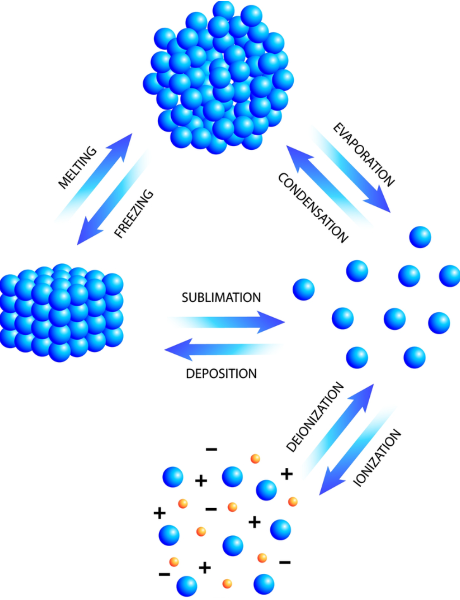
rktz / Shutterstock.com 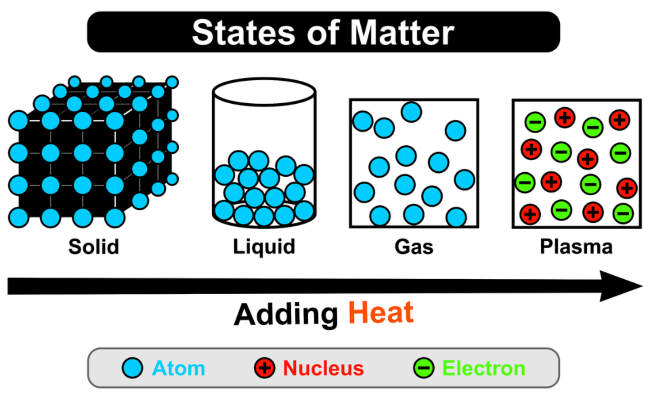
udaix / Shutterstock.com |