Metalanguage from the Study Design
Tenor, register and audience
|
The context will largely determine the tenor of the language used. Tenor refers to the relationships between participants in a language activity and relates especially to social distance. It also involves the level of formality participants adopt (formal, colloquial, etc.). Tenor will be affected by how well people know each other and their purpose for participation. Register – the degree of formality – is inextricably bound with tenor. For close, intimate relationships the register is likely to be informal. For more distant relationships, especially where there is a different hierarchy in the relationships, the register will be more formal. Formality lies on a continuum from highly formal to highly informal, and will be explored further in Week 2. Here is a brief example of the sorts of language that lie along the continuum. 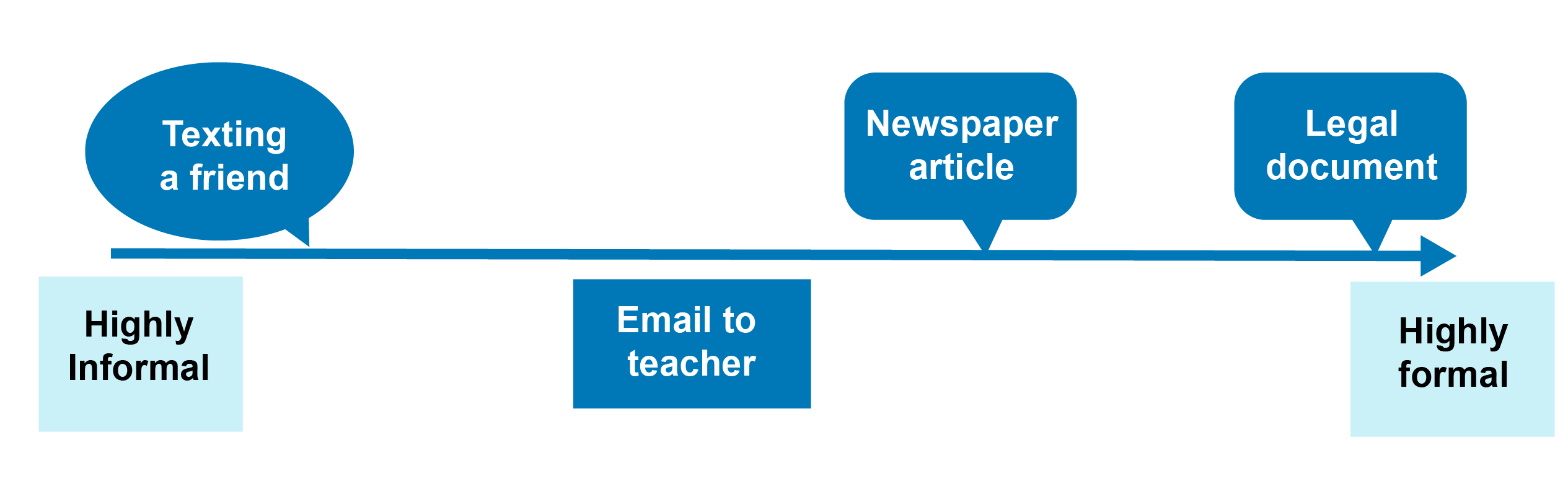
Also, the texts and transcripts you will be exposed to (texts for written discourse, transcripts for spoken) may not be consistent in register throughout. For example, you may find a mostly informal text (e.g. a radio interview) but has formal elements in it (e.g. an Acknowledgement of Country at the beginning). You must be flexible in your thinking and be very responsive to the language in front of you. Audience again depends on context. In a private conversation, the interlocutors are each other's audience. However, in other contexts, such as televised live shows, there might be a range of audiences: a primary audience – i.e. the studio audience, and a secondary audience – i.e. the viewers of the recorded show. |