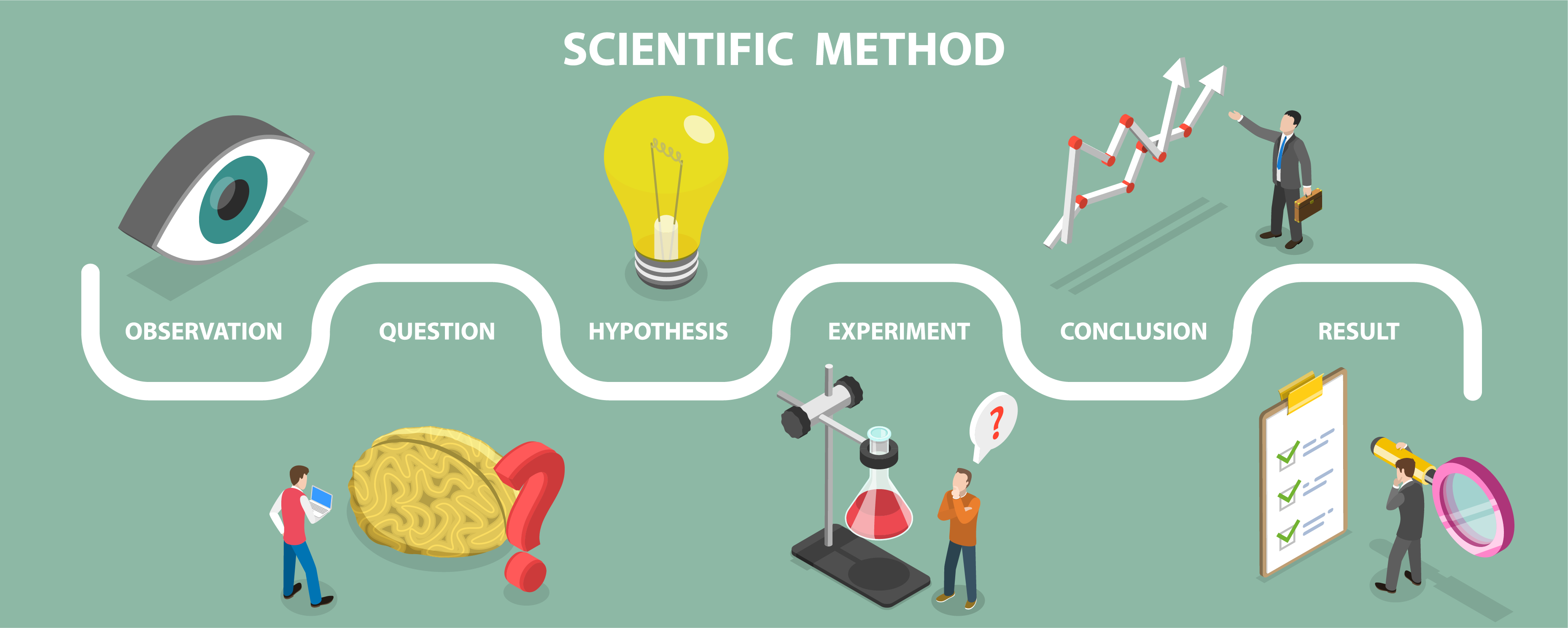
Once a researcher has established their variables, they need to develop the aim / research question for the study and provide an educated guess for what they think the outcome will be, in the form of a hypothesis.
Research question – question that the experimenter hopes to answer.
Aim – research question, restated as a statement. Worded as 'to find the effect of A on B'.
Hypothesis – prediction of the outcome that manipulating the independent variable/s (IV) will have on the dependent variable/s (DV).
Control and experimental conditions – which participants receive the independent variable (experimental condition) and which participants don't (control condition). This allows for a baseline
or point of comparison.
Hypotheses
A hypothesis is often worded in the past tense. It is often written in the following form:
'It was hypothesised that for [the population of interest], the [IV] would have [prediction] impact on the [DV] compared with [comparison with absence
of IV]'.
The population of interest does not need to be included but can help to set up the hypothesis so that all groups being tested are mentioned.
The structure is the same for a multivariable hypothesis, where the additional IV or DV is included alongside the other.
Formulating a hypothesis is an essential step in the scientific method
TarikVision / Shutterstock.com
Example: Chocolate experiment (intelligence)
This is what each element of the experiment might look like when testing the idea that chocolate makes students smarter.
IV: Chocolate consumption
DV: Intelligence levels
Research question: Does chocolate make students smarter?
Aim: To find the effect of chocolate on students' intelligence.
Hypothesis: It was hypothesised that students (population of interest) who consume chocolate (independent variable) will be more (prediction) intelligent (dependent variable) than students who don’t consume chocolate (comparison with absence of independent variable).
Experimental condition: Those who consume chocolate.
Control condition: Those who don't consume chocolate.
Different control and experimental group setups
Sometimes there can be more than one experimental condition in a piece of research. This could be because of a desire to explore different forms or amounts of the IV, or because it is not possible to have a control condition, such as in situations where it isn't possible to have no exposure to the IV. The IV of target heart rate is a good example of this, as it isn't possible to have 'no heart rate'.
Example: Target heart rate experiment (memory)
IV: Target heart rate
DV: Memory performance
Research question: Does target heart rate affect memory?
Aim: To investigate the effect of different heart rates on memory performance.
No control group hypothesis: It was hypothesised that participants (population of interest) who reach a higher target heart rate (independent variable) will recall fewer words (dependent variable) than participants who reach a lower heart rate (comparison with different level of the independent variable).
Experimental condition #1: Participants reach a target heart rate of 100 beats per minute.
Experimental condition #2: Participants reach a target heart rate of 140 beats per minute.
Control condition: Not applicable (N/A)
Multivariable experiments: More than one DV
Let's consider an experiment that measures two different effects of chocolate, testing the idea that chocolate makes students smarter and more coordinated.
Example: Chocolate experiment (intelligence and coordination)
IV: Chocolate consumption
DVs: Intelligence and coordination levels
Research question: Does chocolate make students smarter and more coordinated?
Aim: To find the effect of chocolate on students' intelligence and coordination.
Multivariable hypothesis: It was hypothesised that students who consume chocolate (independent variable) will be more intelligent (dependent variable #1) and have greater hand-eye coordination (dependent variable #2) than students who don’t consume chocolate.
Experimental condition: Those who consume chocolate.
Control condition: Those who don't consume chocolate.
Multivariable experiments: Different levels of an IV
It is rare to have two unrelated IVs in a single piece of research as it can be hard to separate the impact of each one separately. However, different forms or levels of an IV are often compared within the same piece of research.
Let's look at an experiment that uses two different amounts of chocolate when testing the idea that the more chocolate students have, the smarter they will become.
Example: Chocolate experiment (multiple groups)
IV: Chocolate consumption
DV: Intelligence levels
Research question: Does more chocolate make students smarter?
Aim: To find the effect of chocolate on students' intelligence.
More than one experimental group hypothesis: It was hypothesised that students (population of interest) who consume 100 grams of chocolate (independent variable) will be more (prediction) intelligent (dependent variable) than students who don't consume chocolate (comparison with absence of independent variable), but less (second prediction) intelligent than those who consume 180 grams of chocolate (comparison with different amount of independent variable).
Experimental condition #1: Those who consume 180 grams of chocolate.
Experimental condition #2: Those who consume 100grams of chocolate.
Control condition: Those who don't consume any chocolate.