Is there anything beyond death?
Shia Islam's beliefs about afterlife
|
Essential knowledge In Islam, existence after death, either punishment or reward, is one of the Six Articles of Faith, the required beliefs. Doubt about it is considered a serious sin.
|
The Quran's depiction of the stark choiceThe Quran conveys that the world will end with the Day of Judgement, sometimes called the Day of Resurrection. At that time, all the living and dead will be judged and enter either Paradise – the 'gardens with streams running in them ... with fruit ... and mates' (2:25) – for the righteous, or Hell, the 'fire whose fuel is men and stones for the faithless'. (2:24) Muhammad's night journeyAs well as numerous references to the bliss of Paradise and the fire of Hell in the Quran, there is the sacred story of Muhammad's journey to Heaven and Hell to confirm beliefs. The sacred story of the night journey is only briefly mentioned in the Quran but conveyed in detail in hadith, which is the large collection of the stories and saying of Muhammad and other important people. The sacred story The story is that in one night Muhammad was miraculously transported from Mecca to Jerusalem on a winged horse-like creature. Then he was taken to view Heaven and Hell. He eventually met with God where he was instructed about the actions and beliefs required for Muslims to gain Heaven after their death. Physical or merely spiritual? Some Muslims interpret the night journey as a dream-like spiritual experience, but many others insist it was both spiritual and physical, that Muhammad was physically absent from the Earth that night. 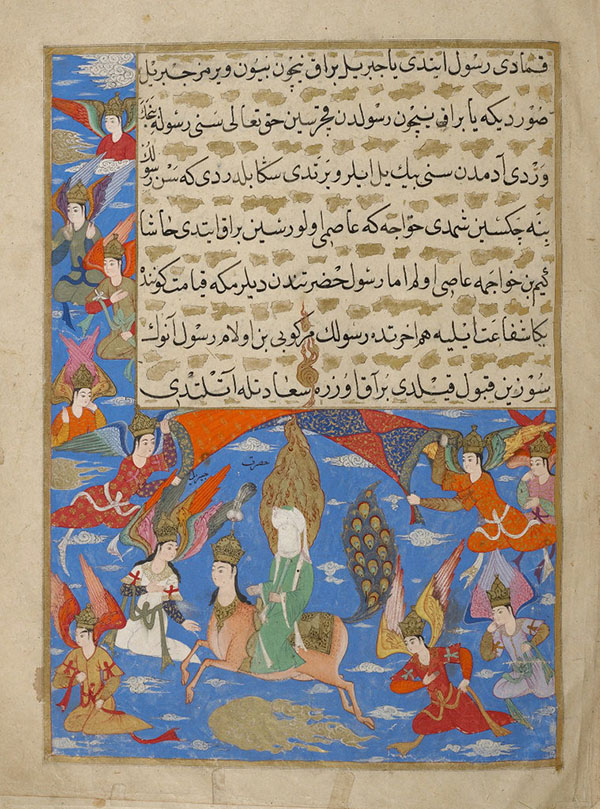
Page from 16th-century Ottoman ruler Murad III’s commissioned copy of Siyer-i Nebi, the Turkish epic about the life of the Prophet by unknown author, public domain. Accessed 27 August 2026. |