Is there an ultimate reality?
Strict monotheism
|
Essential knowledge
The anthropomorphic representation of GodAnthropomorphism is when human characteristics are ascribed to something that is not human. Theologians (the learned scholars of religion) from Judaism, Christianity and Islam tend to insist that God does not have a gender. (The exception is that Christians believe that God became incarnate in the man Jesus.) Despite this lack of gender, male pronouns are commonly used to refer to God and it is likely that many members of these religions conceptualist God as male. (There is now pushback against this gendering by religious feminists.) Human features The sacred texts shared by Jews and Christians and the Quran of Islam have many references to God’s face, hands, arms, eyes, ears and feet; and exhibit God as having a wide range of human-type emotions, such as love, anger, vengeance and compassion. Despite these anthropomorphic descriptions, the three religions agree that God is beyond compare to anything, does not have a bodily form and does not exist in time or space. (The incarnation of Jesus is the exception.) Islam is particularly insistent that God is beyond any conceivable comparison. Christian anthropomorphismMichelangelo reinforced the anthropomorphic image of God with his paintings, as did many other artists. 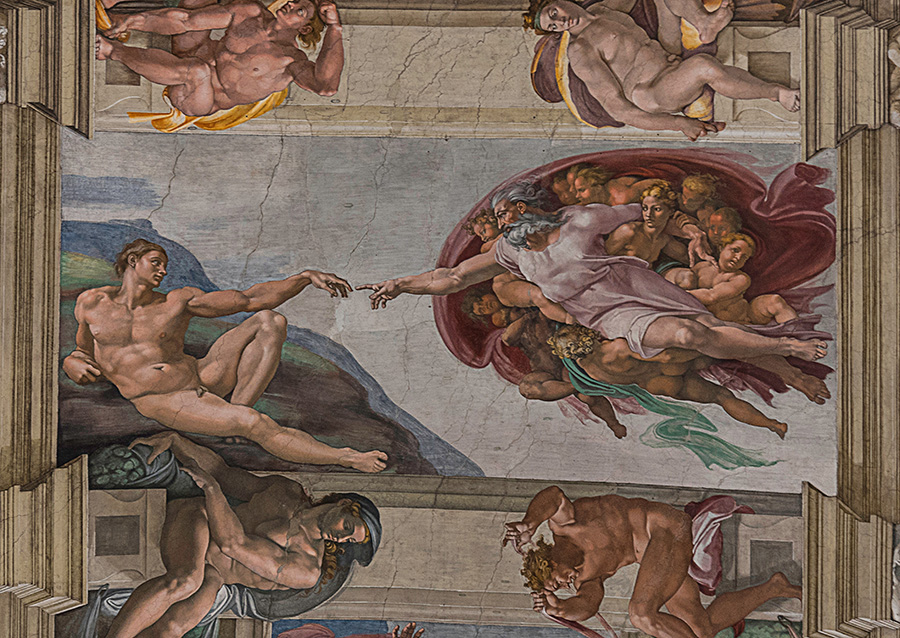
Gush Photography / Shutterstock.com Anthropomorphism is strictly forbidden in IslamAlthough Islamic texts describe God through the use of human traits, referring to body parts and emotions, Islam holds strong views against believing God has these traits and about representing God this way in art. The Quran stresses the transcendence of God, meaning He is beyond the physical realm and beyond time. The end of the Quran verse 42:11, 'Nothing is like Him.' conveys that God does not share similarities with anything in the created world. (Quran translation by Ali Qarai 2018) The Christian Trinity and Islam's view of this beliefChristians insist there is one God, but that God is a Trinity: The Father, The Son and The Holy Spirit. Christians believe that God became incarnate, meaning to be embodied in human form, as Jesus, who willingly died an agonizing death to open the way for humans to gain eternal life and, three days later, ascended to heaven. Although Islam honours Jesus as a prophet it sternly rejects the belief Jesus is God, insisting God has no partners or divisions. Islamic beliefs about Jesus Watch this short video to learn about Muslim beliefs about Jesus. |
|
|