Political actors
|
Note: When you see this symbol of a pencil and paper, you should take your own notes. Don't write down every word! Hello and welcome to Politics at VSV! We are so excited to explore Australian, Indo-Pacific and Global politics with you this year. This first week – and next week – are very much introductory weeks to set the scene for the world’s stage play we will be watching and analysing. Save the links to your bookmarks in your browser to go back to again and again – even in Year 12! Here are the categories of political actors (click the drop-down to expand each one): StateIn VCE Politics, a state (not 'country') is the main actor in the global political system. A state is defined as having a permanent population, defined territory and recognised sovereignty, and it does not need to be culturally the same throughout (for example, Australia). Australia shows these features through its large and growing population of 27 million (including citizens and permanent residents), its clearly recognised land and maritime borders, and its sovereign control over those borders. This sovereign control can be illustrated by Australia's Operation Sovereign Borders policy, under which Australian authorities have intercepted unauthorised maritime arrivals attempting to reach Australia since 2013. We will explore the statehood concept in more depth later this year. For our first Area of Study we are focusing on Australian domestic politics. In order to understand our internal politics, we need to know about the political parties. Political partiesPolitical parties are organised groups with shared views on public policy that aim to win elections and form government. They have formal membership rules, shared values and party discipline, meaning members are expected to vote together and not publicly challenge party positions. Most disagreements are dealt with privately in the party room. In Australia and globally, major parties are facing growing influence from minor parties and independents, which can affect how easily laws are passed. For example, the Australian Government often needs support from The Greens or independents in the Senate to pass legislation.
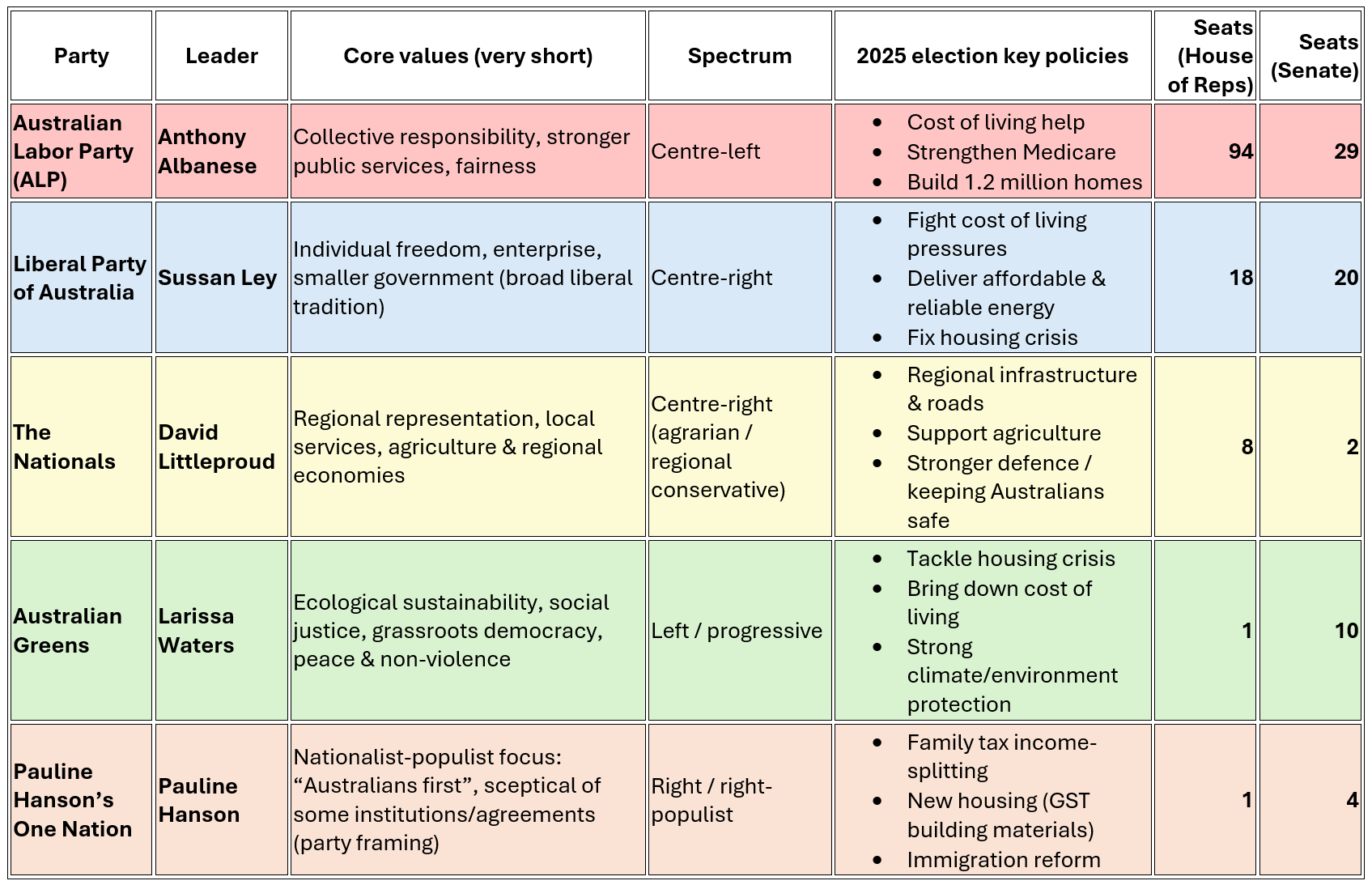
Johannes Leak for The Australian 24 May 2025 The January 2026 debate on new Hate Speech laws triggered the Nationals ending their Coalition arrangement with the Liberal Party. You can read more about this important event here. You might like to add more detail to the table below from your own research using the sources provided. Please note: this is not a formal submission task. Just to expand your understanding if you wish.
 Sources:
https://www.liberal.org.au/our-plan
https://alp.org.au/policies-2025/
https://www.abc.net.au/news/2026-01-24/how-the-coalition-split-played-out/106263654
https://www.onenation.org.au/issues
https://www.nationals.org.au/plan
https://www.buildaballot.org.au/please-explain/minor-parties-and-independents
Here is a quiz you can do to find out which party most aligns with your personal values and opinions on issues that were important in the most recent Federal election in 2025 Non-state actorsIn Politics, we focus on who influences decisions, and how power is used to shape issues, policies and actions. Not all influence comes from governments. Many important influences come from non-state actors (NSAs) – organisations that are not governments and do not run for election, but still shape political debates and outcomes. When studying politics, we don’t label actors as 'good' or 'bad'. Instead, we analyse:
Common types of non-state actors include:
Focus for this Area of Study: Energy Transition and Climate Change For this Area of Study on political power in Australia, our key political issue is the energy transition and climate change policy. We will examine how different non-state actors try to influence government decisions in this area. Our two main NSA case studies are:
Transnational Corporations (TNCs)A transnational corporation is a company that
operates in more than one state. (In this subject, always use TNC,
not 'multinational'.) News Corp, owned by Rupert Murdoch, is a major TNC that operates across Australia, the UK and the US. It plays a powerful role in shaping how political issues – including climate change and energy – are framed and discussed.
Non-Governmental Organisations (NGOs)NGOs are organised groups with a clear mission that campaign on specific issues. Many operate globally to increase their influence and share resources. They often aim to pressure governments, raise public awareness and change policy. Greenpeace, founded in 1971, is a global environmental NGO with a strong presence in Australia. It campaigns on climate change, fossil fuels and environmental protection, making it a key actor in debates about Australia’s energy transition.
Across the course, we will analyse how both Greenpeace and News Corp use power in different ways to influence Australia’s climate and energy policies, and what this tells us about political power beyond government. |


