Mean versus median
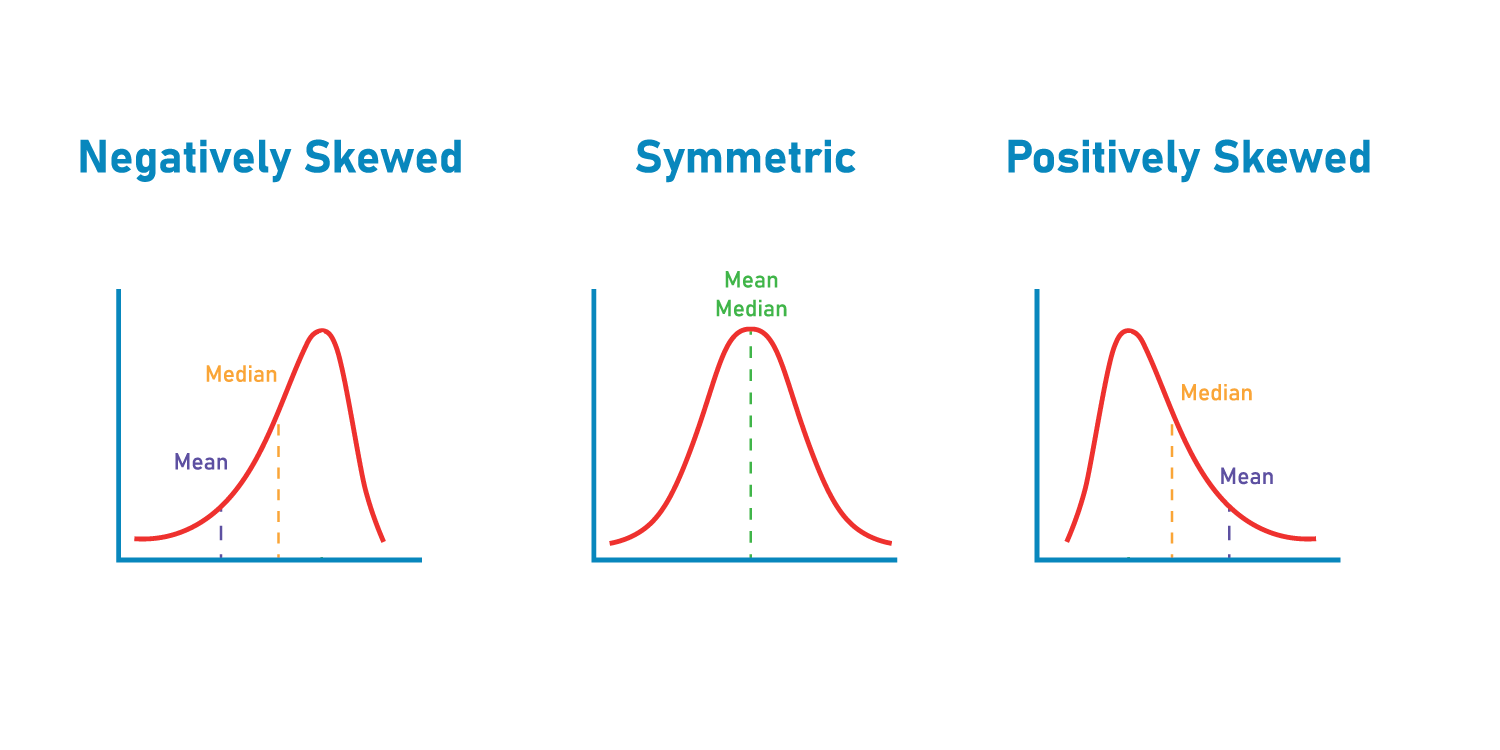
Adapted from Dream01 / Shutterstock.com An important part of summary statistics is deciding which summary statistic, or statistics, we should use to describe what is going on for data. When we are talking about the centre – or central tendency – of a set of data, we always use median or mean. Which one we use depends on the type of data we have. Have a look at the image above. Can you see how, for symmetrical sets of data, the mean and median are the same? However, for the skewed ones, mean and median are different. So which one should we use? To give you a hint, search 'mean house price Perth' on Google. Do the results refer to the 'mean' price? Take a look at the following barchart. Does it give you a hint about why we typically talk about 'median house prices' and not 'mean house prices'? It's clear the house prices are not symmetrical. Do you think the fact that they are negatively skewed has anything to do with the fact that our search results don't return any 'mean house prices'?' You’d better believe it does! Choosing between mean and median as the measure of central tendency is pretty straight forward. Copy down the notes below to help you remember which one you should use when. |
|
Take some notes on this topic that will be meaningful to you as a future reference. Choosing between mean and median as a measure of central tendency:
|
|
Here is an example of some data, and why it makes sense to use median, rather than mean, for this data. Example: Imagine you want to know the general age of people in a Year 11 classroom. You ask everyone in the room how old they are. The data you get is as follows (in years): 17, 16, 17, 17, 18, 16, 17, 45 Think about how would you answer the following question: 'Most people in this room are around _____ years old.' Would you use the mean, which is 20.38 years (rounded to the nearest hundredth), or would you use the median, which is 17 years? Obviously, 45 is an outlier from the general trend of the data. Even though most people in this group are around 17 years, the outlier 'pulls' the mean up to almost 21. This is why we use median when there is an outlier. Next, let’s check your understanding of mean versus median. |