Phonetics and phonology: Introduction
|
Phonetics is the study of human speech sounds. It is concerned with the actual physical sounds that human beings utter in making intelligible speech and with the mechanics and acoustics of speech, such as where we make sounds in the mouth or the places of articulation. Phonology is the study of the sound systems and different patterns of sound that can occur in a particular language. Some linguists spend a lot of their time studying just how language sounds. In English, there are 26 letters in the alphabet, but in Australian English there are 44 speech sounds that we use. Think of the letter 'A', for example. There are quite a few variations in its pronunciation. The 'a' in 'at' is the same as the 'a' in 'cat' and 'bat' but not the same as the a in 'call' or 'ball', and it is different again from the 'a' in 'say', 'day' or 'lay'. If we are native English speakers, we grow up learning these sound variations without additional alphabets; however, the International Phonetic Alphabet (IPA) exists to chart out the unique representation of each sound that occurs in language. You do not have to memorise the IPA – that is well beyond the scope of this study. If we ever do work with the IPA, a chart will be given to you. All we are doing is having a quick look at the IPA and getting our heads around the fact that there is, in fact, an alphabet that can articulate every sound possible in language. If you've ever looked up a word in a dictionary, you will also find that the IPA is set out alongside or underneath the word; now you know what that is. Look up a free online dictionary, such as Merriam-Webster. Search a few words you know how to pronounce. Look at the IPA pronunciation, then click on it. The pronunciation exactly mirrors the IPA symbols. Watch this video for some quick and useful tips on how to translate words from the IPA. The IPA is divided into consonants and vowels. We will start with the consonants. Have a look at the following interactive IPA chart: You can hover over the symbols to hear the sounds spoken aloud. We know there is a lot of information and a lot of symbols. Don't worry, we are just having a quick look. The IPA will not be an integral aspect to this course. Note: When you click on the link, scroll down – if you click on the first hyperlink, it will send you to a Wikipedia article about IPA. This site, however, is simpler to use. You may also find the IPA charts useful on p. 168 and p. 171 of Love the Lingo (3rd edition) or pp. 206–7 (4th edition). 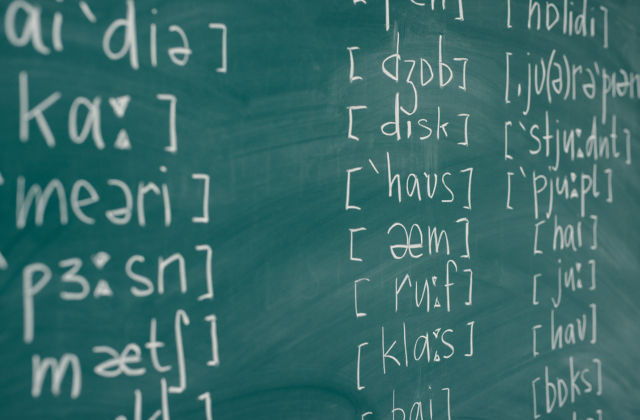
Undrey / Shutterstock.com Alongside the IPA are the movements we make with our mouth, teeth, tongue, larynx, and so on, in order to make sounds. These are known as the places and manners of articulation. Places of articulationPlaces of articulation describe the different ways in which we move our lips, teeth, tongue and so on to make word sounds. Again, you do not need to memorise the list, which you will find in full in Love the Lingo on p. 169 (3rd edition) or p. 207 (4th edition). However, for now let's just get a few terms under our belt. Bilabial: where you use both lips to pronounce a sound. When you say 'p' in paper, 'b' in baby and 'm' in memo, for example, notice how your lips touch together. You cannot say 'paper' without your lips meeting twice. Labio-Dental: uses the lower lip and the upper teeth. Think about any word beginning with 'f' or 'v'. Say 'fi, fie, foe, fum' or 'vulgar villainous Veronica'. Every time you use the consonant 'f' or 'v', your teeth lightly touch your bottom lip. Once again, you cannot say these consonants without these movements. 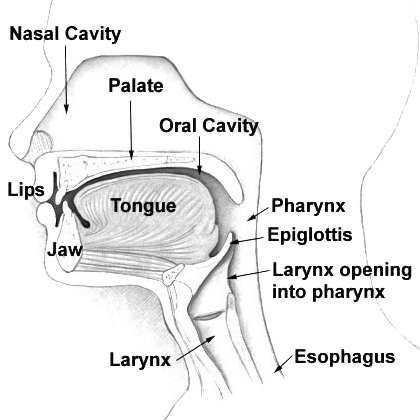
SEER Training Modules: Head & Neck Overview by U.S. National Institutes of Health, National Cancer Institute, public domain. Accessed 17 August 2026. Manners of articulationManners of articulation refer to the way airflow is managed to create different sounds in the consonants. Some consonants are 'voiced', that is, the vocal cords are engaged; others are 'non-voiced', meaning that vocal cords are not used. Again, you do not have to memorise this, but the diagram above shows places of articulation. We will just do a few exercises to demonstrate that you can use the chart and follow the definitions. To read the definitions of manners of articulation, go to p. 170 (3rd edition) or p. 208 (4th edition) of Love the Lingo. |